Quick answer
Skid Steer Services in Oceanside, CA costs $150 per hour with a 4-hour minimum ($600), operator and fuel included, plus a flat travel charge quoted before you book. Typical jobs: spread two truckloads of gravel or road base on a driveway, about 4 hours ($600); backfill a foundation or utility trench after inspection, about 4 hours ($600).
At a glance
- Rate
- $150 per hour, machine and operator
- Minimum
- 4-hour minimum ($600)
- Travel
- Flat charge, quoted before you book
- Zip codes
- 92054, 92056, 92057, 92058
What skid steer services looks like in Oceanside
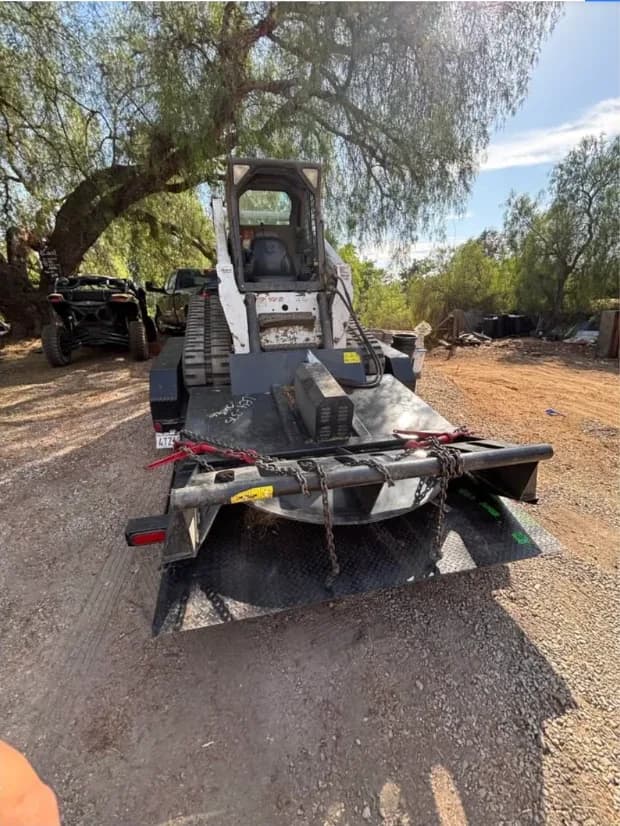
Skid steer work in Oceanside usually involves leveling and spreading material on the inland tract lots, loading out broken concrete on older lots, and bigger clearing and road work on the South Morro Hills farms. In Rancho del Oro, Ivey Ranch and the College Boulevard tracts the first question is the side gate, since the T300 needs about 7 feet; near the coast many side yards are narrower and the mini excavator takes over. Oceanside's sand and clay compact differently from inland granite, so we track-roll fill in thin lifts. In South Morro Hills the T300 runs the brush cutter along grove edges and spreads base on the farm roads off North River Road.
A typical skid steer services job in Oceanside
Post-remodel cleanup on a Rancho del Oro lot: about $850 to $1,350 plus travel
A typical example: a backyard remodel in Rancho del Oro is done except for the mess, with broken block, old sod, form boards and a mound of footing spoil across the yard. Where the side gate opens to about 7 feet, the T300 drives in over plywood, scrapes the debris into piles, carries it out to a 10-yard roll-off on the driveway, and rough-levels the leftover dirt for the landscaper. That runs 4 to 6 hours, $600 to $900, plus one haul-off load at about $250 to $450, so roughly $850 to $1,350 plus the flat travel charge.
A worked example on normal ground. Your hours depend on the ground, the access and the material.
Typical hours and cost in Oceanside
Everything is $150 per hour with a 4-hour minimum, plus the flat travel charge. These are the common versions of the job on normal ground.
| Typical job | Hours | At $150 per hour |
|---|---|---|
| Spread two truckloads of gravel or road base on a driveway | 4 | $600 |
| Backfill a foundation or utility trench after inspection | 4 | $600 |
| Rough-grade a 2,000 sq ft pad for a shed, barn or ADU | 4 to 8 | $600 to $1,200 |
| Clean up a construction site and load debris | 4 to 6 | $600 to $900 |
| Move and place 40 to 60 tons of DG or fill dirt | 6 to 10 | $900 to $1,500 |
| Clear a quarter acre of light brush with the brush cutter | 4 to 6 | $600 to $900 |
Hours are typical ranges for normal ground and access. Rock, roots, steep slopes and tight gates add time. Material, haul-off and dump fees are quoted separately. 4-hour minimum applies.
What is included
- ✓Bobcat T300 compact track loader delivered to your property on our trailer
- ✓An experienced operator for every billed hour, fuel included
- ✓General-purpose bucket for dirt, gravel, DG and debris; tooth bucket for hard ground
- ✓Brush cutter, auger, breaker and pallet-fork attachments when the job calls for them
- ✓Spreading and rough leveling of material you have delivered, or material we arrange
- ✓Site walk before we start and a clean, raked finish before we load up
The ground in Oceanside
Oceanside is not decomposed granite country like Fallbrook. Across much of the city the ground is marine terrace sand over the sandstone and claystone of the Santiago Formation, and the claystone layers can be expansive, swelling when wet and shrinking when dry, which cracks slabs and walls built on it. Some hillsides in the city are mapped as old landslides. The San Luis Rey River valley floor is river sand and silt, easy digging but loose, and the river runs its last 7 miles to the ocean in a leveed earthen channel. The ground changes from one neighborhood to the next, so we look before we quote.
Permits in Oceanside
Oceanside permits come from the City: its Engineering Division handles grading and its Building Division handles demolition, and the City's own guidance says grading or other alterations to private property may trigger a permit. Leveling a backyard, trenching on your own lot and pulling out a patio usually need none; building pads, larger cut and fill, retaining walls, work that changes drainage and demolition of permitted structures can. Lots in the coastal zone or in the river and creek flood zones can need extra Planning or floodplain review, and demolition in the coastal zone or of a historic building carries extra Planning requirements. Many inland tracts have HOAs. South Morro Hills is inside city limits, so it is the City there too, not the County.