SoCal Dirt Movers, Fallbrook, CA • Updated
Quick answer
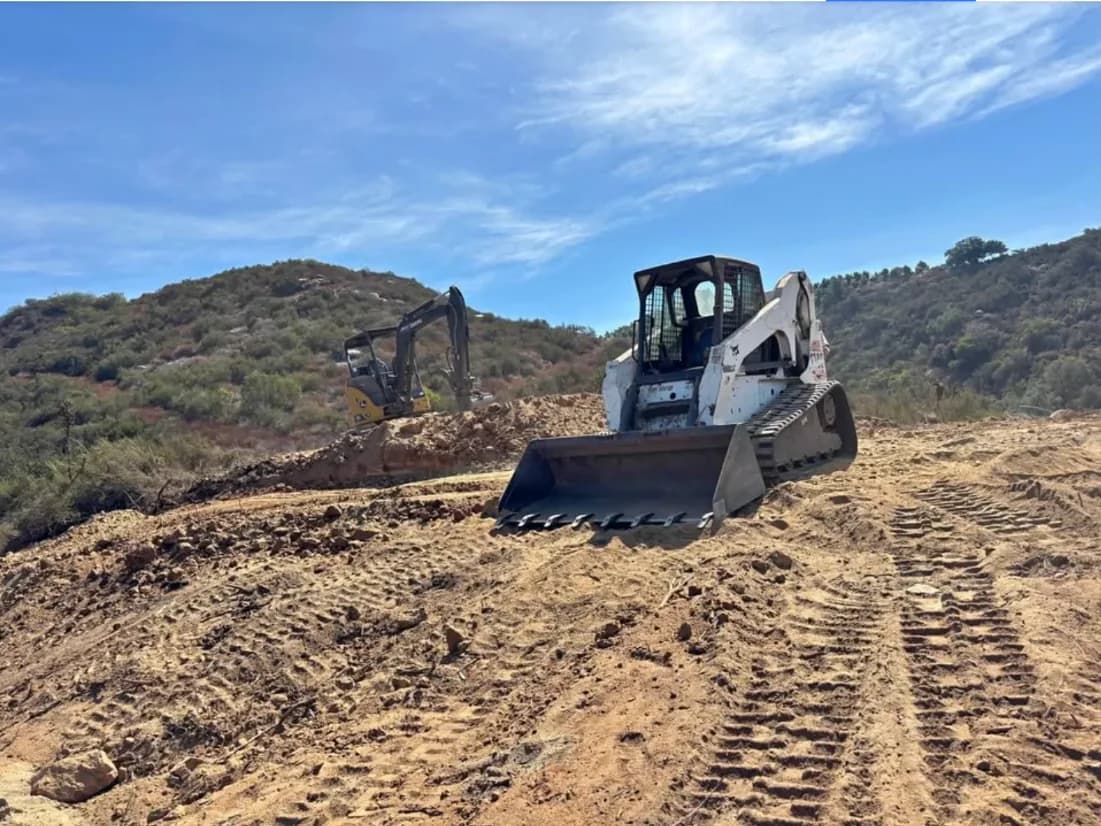
A skid steer moves, spreads and grades dirt and gravel and clears brush, while a mini excavator digs trenches, footings, stumps and drainage. In Fallbrook and North San Diego County we run both at $150 per hour with an operator and a 4-hour minimum ($600). Many jobs use both on one trailer trip: the excavator digs, and the loader backfills and grades.
At a glance
- Skid steer (Bobcat T300)
- Moves, spreads, grades, backfills, clears brush
- Mini excavator
- Digs trenches, footings, stumps and swales; lifts boulders
- Rate
- $150 per hour for either or both, 4-hour minimum ($600)
- Gate width
- T300 needs about 7 ft; the excavator fits a narrower gate
- Jobs that use both
- Trench and backfill, French drains, hillside pads, grove removal
What is the difference between a skid steer and a mini excavator?
A skid steer is a loader that drives into material and carries it, and a mini excavator is a digger that sits in one place and pulls material up from below its tracks. The loader works the surface of the ground. The excavator works under it.
Our skid steer is a Bobcat T300 compact track loader: about 81 horsepower, a rated operating capacity of about 3,000 pounds, roughly 6.5 feet wide, on rubber tracks. It pushes, carries, spreads and grades, and runs a general-purpose bucket, a tooth bucket, a brush cutter a little over 6 feet wide, an auger, a hydraulic breaker and pallet forks.
The mini excavator has a boom, an arm and a bucket on an upper body that swings, so it digs a trench and sets the spoil beside it without moving. It carries a hydraulic thumb for stumps, boulders and debris, and 12, 18 and 24 inch trenching buckets for the widths plumbers and electricians ask for.
| Feature | Skid steer (Bobcat T300) | Mini excavator |
|---|---|---|
| Built for | Moving, spreading, grading, backfilling, clearing brush, loading | Digging trenches, footings, stumps and swales; lifting boulders |
| How it works | Drives into a pile or a cut and carries the load | Stays put, digs below grade and swings the spoil to one side |
| Ground disturbance | Travels over the whole work area; turns can scuff a lawn | Disturbs a narrow strip plus the spoil pile |
| Gate width | About 7 ft opening | Fits a narrower gate than the T300 |
| Slopes | Tracks hold on slopes and soft DG where a wheeled machine slips | Reaches up or down a bank from a spot a loader cannot stand on |
| Attachments | Buckets, brush cutter, auger, hydraulic breaker, pallet forks | Thumb, 12, 18 and 24 inch trenching buckets, grading bucket, breaker |
| Weak at | Deep, narrow trenches and pulling stumps | Carrying material across a lot or spreading a truckload |
| Rate with operator | $150/hr, 4-hour minimum | $150/hr, 4-hour minimum |
Which machine does my job need?
Match the machine to the main verb of the job: moving, spreading or leveling is skid steer work, digging down is excavator work, and a job that does both gets both. Typical hours below are billed at $150 per hour.
| Job | Machine | Typical hours |
|---|---|---|
| Spread 20 tons of DG or base rock on a driveway | Skid steer | 4 |
| Regrade and crown a 300 ft dirt driveway | Skid steer | 4 |
| Level a 12 x 20 ft shed pad | Skid steer | 4 |
| Level a 2,000 sq ft backyard | Skid steer | 4 to 6 |
| Clear a half acre of weeds and light brush | Skid steer with brush cutter | 4 to 8 |
| Break up and load a 400 sq ft patio | Skid steer with breaker | 4 |
| Trench 100 ft for a water or irrigation line | Mini excavator | 4 |
| Dig footings for a 60 ft retaining wall | Mini excavator | 4 to 6 |
| Pull 6 to 10 stumps | Mini excavator | 4 to 8 |
| Install 100 ft of French drain | Both | 4 to 6 |
| Cut and fill a pad into a hillside | Both, loader doing most of it | 8 to 16 |
| Remove a dead avocado grove, per acre | Both | 12 to 24 |
Holes are the one digging job the loader handles well: the T300 auger drills post holes and tree holes cleanly. Anything long and narrow, like a water line, is excavator work; see trenching cost per foot.
Why do so many jobs use both machines?
Most jobs that dig also move dirt, so the excavator digs and the loader handles what comes out. Both machines ride on our trailer on the same trip, there is one operator, and the hour costs $150 whichever seat he is in, so bringing both adds nothing to the rate and usually shortens the job.
- Trench and backfill. The excavator cuts the trench and piles the spoil. After your inspection it backfills and the loader track-rolls the fill, typically 2 to 4 hours.
- French drains. The excavator digs the trench, and the loader brings drain rock from the pile at the driveway so nobody pushes a wheelbarrow.
- Hillside pads. The loader does the cut and fill; the excavator cuts the tight corners and hard banks and pulls boulders out of the pad.
- Grove removal. The brush cutter or the loader takes the trees down, and the excavator pulls each stump and root ball so the ground can be graded.
You do not have to pick. Describe the job, and the right machine, or both, shows up. One rate and one 4-hour minimum cover the trip either way; the pricing page lists typical hours for every service.
Does a mini excavator cost more than a skid steer?
No. With us, the mini excavator and the skid steer are both $150 per hour with an operator and fuel, the same 4-hour minimum ($600), and the same half-hour billing after the minimum. When both come on one trip you pay one rate and one minimum, not two.
Renting is different: each machine is its own rental and its own delivery, and you run both. See renting a skid steer vs hiring an operator.
What can a skid steer not do?
A skid steer does not dig deep, narrow trenches or pull stumps well. Its bucket is about as wide as the machine, so a trench cut with it is a wide, shallow ditch, and a stump with a full root ball needs the reach and the thumb of the excavator.
- It cannot haul material off the property. Debris, concrete or spoil that has to leave goes in a dump trailer or a roll-off, quoted separately.
- The brush cutter takes brush and saplings up to a few inches thick. Bigger trees need the excavator or a saw.
- Some slopes are too steep for any machine. We walk steep lots first and say plainly if part of one is beyond what the machines should be on.
Typical hours and jobs are on the skid steer services page.
What can a mini excavator not do?
A mini excavator is slow at moving material across a property. It digs and loads from where it sits, so carrying a pile across the lot or spreading a truckload of base goes faster with the loader.
- It does not haul off site either. It loads the truck, and the truck hauls.
- It will not dig near unmarked public lines. Every dig starts with an 811 ticket, which is free and takes 2 working days.
- Its reach is sized for residential work. Utility trenches, typically 18 to 24 inches deep, and footings 12 to 24 inches below grade are well within it. For anything unusual on an engineer's plan, send the plan and we confirm before booking.
- Large boulders and ledge rock need the hydraulic breaker, which adds hours we tell you about when we hit it.
Trenching, footing and stump work is covered on the mini excavator services page.
Which machine fits my gate and my slope?
The T300 needs a gate opening of about 7 feet and the mini excavator fits a narrower one, so a tight side yard often decides the machine before the job does. Many Temecula tract gates are 4 to 6 feet wide. There the excavator does the yard with a smaller bucket, or we take down a fence panel for the day and reset it.
On slopes, both machines run on tracks. The loader climbs and holds on Fallbrook decomposed granite where a wheeled machine slips, and the excavator can sit on a bench and reach up or down a bank where a loader cannot stand. Tell us the gate width when you text and we plan the access before the trailer leaves.
How do I ask for the right machine?
Describe the finished result, not the machine. Text 3 or 4 photos of the area with something in the frame for scale, the gate width, and anything you know is buried, and we reply the same day with the machine, or both, and a range of hours.
For bigger grading, clearing and drainage jobs we walk the property first at no charge. The person who quotes the hours is the person in the seat.
Questions people ask
Is a compact track loader the same as a skid steer?
Close enough for most jobs. A compact track loader is a skid steer on rubber tracks instead of tires, steered the same way and running the same attachments. Our Bobcat T300 is a tracked loader, which is why it holds on Fallbrook slopes and soft ground where a wheeled skid steer slips, and why it leaves less damage on a lawn or a driveway.
Can a skid steer dig a trench?
Only a wide, shallow one. A loader bucket is about as wide as the machine, so it cuts a ditch rather than a trench. For an 18 to 24 inch water, irrigation or conduit trench, the mini excavator with a 12, 18 or 24 inch trenching bucket cuts a straight, narrow line and piles the spoil beside it for backfill.
Can a mini excavator level a yard?
It can shape small areas, swales and the edges of a pad with a grading bucket, but it is slow at carrying and spreading material. Leveling a 2,000 sq ft backyard is typically 4 to 6 hours of loader work. On jobs that need both, the excavator shapes the tight spots and the loader does the open ground.
Which machine is easier on a lawn or a driveway?
Usually the excavator, because it stays in one spot and disturbs a narrow strip, while a loader travels over the whole work area. Both run on rubber tracks. We plan the route in and out before we unload and lay plywood over any lawn or paver path we have to cross.
Do I pay double if both machines come?
No. There is one operator and one rate: $150 per hour with a 4-hour minimum, whichever machine is running. Both machines come on the same trailer trip when a job needs them, so a trench and its backfill, or a pad with stumps in it, is billed as one job, by the half hour after the minimum.
Which machine pulls stumps and boulders?
The mini excavator. It digs around the root ball, and the hydraulic thumb grips the stump or boulder and lifts it out whole. The skid steer can push over small dead trees and carry what the excavator pulls to a pile. Boulders too big to lift get broken with the hydraulic breaker or graded around, and we tell you which when we hit one.
How these numbers are worked out. Labor is our published rate, $150 per hour with a 4-hour minimum, times the hours these jobs typically take on normal ground. Material prices are typical delivered prices from North County yards and change with the yard and the distance. For a number on your job, text photos to (442) 271-2748 or send the estimate form.