Quick answer
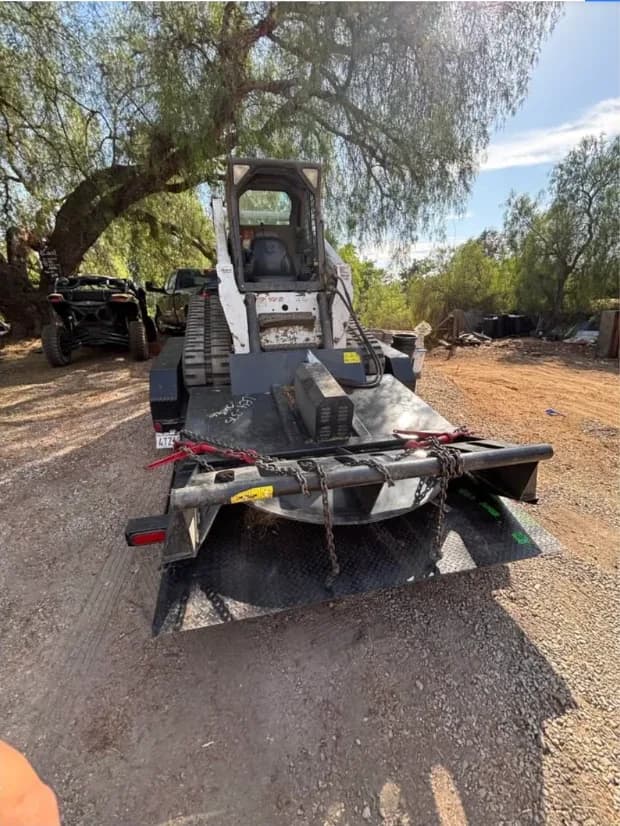
Trenching in Oceanside, CA costs $150 per hour with a 4-hour minimum ($600), operator and fuel included, plus a flat travel charge quoted before you book. Typical jobs: trench 100 feet for a water or irrigation mainline, about 4 hours ($600); trench 200 feet of conduit to a shop, well pump or gate, about 4 to 6 hours ($600 to $900).
At a glance
- Rate
- $150 per hour, machine and operator
- Minimum
- 4-hour minimum ($600)
- Travel
- Flat charge, quoted before you book
- Zip codes
- 92054, 92056, 92057, 92058
What trenching looks like in Oceanside
Trenching in Oceanside usually involves water, sewer and power runs to ADUs and garages, irrigation lines in the inland tract yards, and longer irrigation mainlines and pump power on the South Morro Hills farms, where there is no city sewer. The coastal sand digs fast but caves, so trenches near the beach are opened and closed quickly. Claystone further inland is stiff when dry and sticky when wet. Older lots near downtown hide abandoned pipe and private lines that 811 does not mark. We cut to the depth your plumber or electrician sets, usually 18 inches for water and PVC conduit, and backfill after the inspection.
A typical trenching job in Oceanside
Irrigation mainlines for a new 2-acre planting in South Morro Hills: about $900 to $1,500 plus travel
A typical example: a South Morro Hills farm is replanting a 2-acre block and needs a grid of irrigation mainlines from the existing valve station down the rows. The mini excavator cuts the mains 12 to 18 inches deep, the depth irrigation contractors usually ask for, laying spoil on one side so the installer can glue pipe behind us. Farm roads and drip laterals already in place get flagged first. On open ground that grid is 6 to 10 hours, $900 to $1,500, plus the flat travel charge, with backfill after the line is tested billed by the hour.
A worked example on normal ground. Your hours depend on the ground, the access and the material.
Typical hours and cost in Oceanside
Everything is $150 per hour with a 4-hour minimum, plus the flat travel charge. These are the common versions of the job on normal ground.
| Typical job | Hours | At $150 per hour |
|---|---|---|
| Trench 100 feet for a water or irrigation mainline | 4 | $600 |
| Trench 200 feet of conduit to a shop, well pump or gate | 4 to 6 | $600 to $900 |
| Trench a grid of irrigation mainlines for a new grove or landscape | 6 to 10 | $900 to $1,500 |
| Trench 150 feet of drain line from downspouts to daylight | 4 to 6 | $600 to $900 |
| Trench water, sewer and power to a new ADU | 6 to 12 | $900 to $1,800 |
| Backfill and compact after inspection (often same day) | 2 to 4 | $600 |
Hours are typical ranges for normal ground and access. Rock, roots, steep slopes and tight gates add time. Material, haul-off and dump fees are quoted separately. 4-hour minimum applies.
What is included
- ✓Trench cut to the depth and width on your plan or your trade's instruction
- ✓Spoil piled on one side, clear of the trench edge, ready for backfill
- ✓Rock and roots removed with the thumb and tooth bucket
- ✓Backfill in lifts after inspection, track-rolled with the Bobcat
- ✓Sand bedding spread in the trench when the line calls for it
- ✓Surface raked and graded so the trench line disappears
The ground in Oceanside
Oceanside is not decomposed granite country like Fallbrook. Across much of the city the ground is marine terrace sand over the sandstone and claystone of the Santiago Formation, and the claystone layers can be expansive, swelling when wet and shrinking when dry, which cracks slabs and walls built on it. Some hillsides in the city are mapped as old landslides. The San Luis Rey River valley floor is river sand and silt, easy digging but loose, and the river runs its last 7 miles to the ocean in a leveed earthen channel. The ground changes from one neighborhood to the next, so we look before we quote.
Permits in Oceanside
Oceanside permits come from the City: its Engineering Division handles grading and its Building Division handles demolition, and the City's own guidance says grading or other alterations to private property may trigger a permit. Leveling a backyard, trenching on your own lot and pulling out a patio usually need none; building pads, larger cut and fill, retaining walls, work that changes drainage and demolition of permitted structures can. Lots in the coastal zone or in the river and creek flood zones can need extra Planning or floodplain review, and demolition in the coastal zone or of a historic building carries extra Planning requirements. Many inland tracts have HOAs. South Morro Hills is inside city limits, so it is the City there too, not the County.