SoCal Dirt Movers, Fallbrook, CA • Updated
Quick answer
Class II road base, at roughly $25 to $45 a ton delivered, is the right surface for most driveways and private roads in Fallbrook and North San Diego County: it packs hard, sheds water and holds a slope. Decomposed granite falls in the same price range and looks cleaner, but dusts and rinses off slopes. Gravel drains well but rolls and ruts under tires.
At a glance
- Price, all three
- Roughly $25 to $45 a ton delivered
- Driveways and roads
- Class II road base, 3 to 4 in compacted
- Paths and flat courtyards
- DG, stabilized with a binder on paths
- Drainage and wash crossings
- 3/4-inch gravel
- Coverage at 3 in deep
- Roughly 70 to 80 sq ft per ton
- Weight
- Roughly 1.4 to 1.5 tons per cubic yard
Which should go on a driveway: road base, DG or gravel?
Road base is right for almost every driveway and private road that cars and trucks use daily. Class II base is crushed rock graded from coarse stone down to fines, so when it is spread damp and compacted, the fines fill the gaps between the stones and the layer locks into a hard crust that sheds water. Decomposed granite is right for short, flat driveways, courtyards and paths where the look matters. Gravel is right where you want water to pass through the surface, not over it.
In Fallbrook, Bonsall and Valley Center the decision usually comes down to slope. Most driveways here climb, and on a climb, road base is the only one of the three that holds its shape through a winter storm.
How do road base, DG and gravel compare?
Road base wins on most of what a driveway needs, DG wins on looks and gravel wins on drainage. The table compares the three as they behave on North County driveways.
| What matters | Class II road base | Decomposed granite (DG) | 3/4-inch gravel |
|---|---|---|---|
| Packs hard | Yes, locks into a firm crust | Moderately; softens when wet | No, the stones roll |
| Sheds water | Yes, with a crown | Partly; water soaks in and carries fines | No, water passes through |
| Drainage through it | Low | Moderate | High |
| Dust | Some in summer | The most; tracks indoors | Very little |
| Look | Gray or tan, plain | Warm tan, finished | Loose stone |
| On slopes | Holds well | Rinses off in storms | Rolls downhill, ruts |
| Price, delivered | Roughly $25 to $45 a ton | Roughly $25 to $45 a ton | Roughly $25 to $45 a ton |
| Typical depth | 3 to 4 in compacted | 2 to 3 in on paths | 2 to 3 in over base |
| Typical use | Driveways, private roads, pads, parking | Paths, patios, short flat drives | Drainage areas, wash crossings, French drains |
When is road base the right choice?
Road base is the right choice for any driveway that climbs, carries delivery trucks or horse trailers, or serves more than one house. It is the material that holds a crown, and the crown is what sends water to the ditch before it cuts a rut. A 3-inch lift on a regraded dirt driveway is the usual job. On soft ground, or a new driveway that will carry heavy trucks, 4 to 6 inches laid in two lifts holds up longer.
Some yards also sell recycled base, crushed from old concrete like the patios we break out around Fallbrook. If an engineer's plan names a specification, order that product by name. For a full cost table by driveway length, see what dirt driveway grading costs.
When is decomposed granite the right choice?
DG is the right choice on flat or nearly flat ground where the look matters: a short driveway near the house, a courtyard, a garden path, the space between pavers. It is the native soil of most of Fallbrook, screened to a finer, more even grade, and it gives a warm, natural finish that road base does not.
DG rinses off slopes because it is mostly fine particles with few large, angular stones to lock it together. Rain soaks the top layer, the water starts moving downhill, and it carries the fines with it. On a slope the water gains speed and small rills become ruts within a storm or two. Bare DG cut slopes erode the same way, which is why we treat hillside erosion as a water problem first.
For paths, stabilized DG holds up much better. A binder, either a plant-based powder or a polymer, is mixed into the DG before it is spread, wetted and compacted, so the surface sets firm and resists washing and tracking. It is a path and patio product, not a surface for trucks, and the binder maker's mixing and watering steps matter.
When is gravel the right choice?
Three-quarter-inch gravel is the right choice where water needs to pass through the surface: drainage areas, the dip where a driveway crosses a wash, around a culvert outlet, and inside French drains. Clean gravel has no fines to bind it, so it never packs. That is a feature in a drain and a problem under tires.
On a driveway, gravel works as a thin top dressing over compacted road base on flat ground, where it cuts dust and mud at the door. On a slope it rolls downhill, and on soft dirt it ruts and sinks. Laid deeper than 2 to 3 inches, it gets loose underfoot and under tires.
How deep should each one go, and how much do I need?
Plan on 3 to 4 inches of compacted road base on a driveway, 2 to 3 inches of DG on a path, and no more than 2 to 3 inches of gravel as a top dressing. At roughly 1.4 to 1.5 tons per cubic yard, 1 ton covers roughly 70 to 80 square feet at 3 inches deep and about 110 square feet at 2 inches. The math is length x width x depth in feet, divided by 27 for cubic yards, times 1.4 to 1.5 for tons.
- 300 x 10 ft driveway, 3 in of road base: 750 cubic feet, about 28 cubic yards, roughly 38 to 42 tons.
- 40 x 12 ft parking pad, 4 in of road base: 160 cubic feet, about 6 cubic yards, roughly 8 to 9 tons.
- 100 x 4 ft garden path, 2 in of DG: about 67 cubic feet, about 2.5 cubic yards, roughly 3.5 tons.
Order 15 to 25 percent more than the measured tons to cover compaction and waste, so the path above becomes a 4 to 4.5 ton order. For odd shapes and fill dirt, use how much fill dirt or base to order.
How is it spread and compacted?
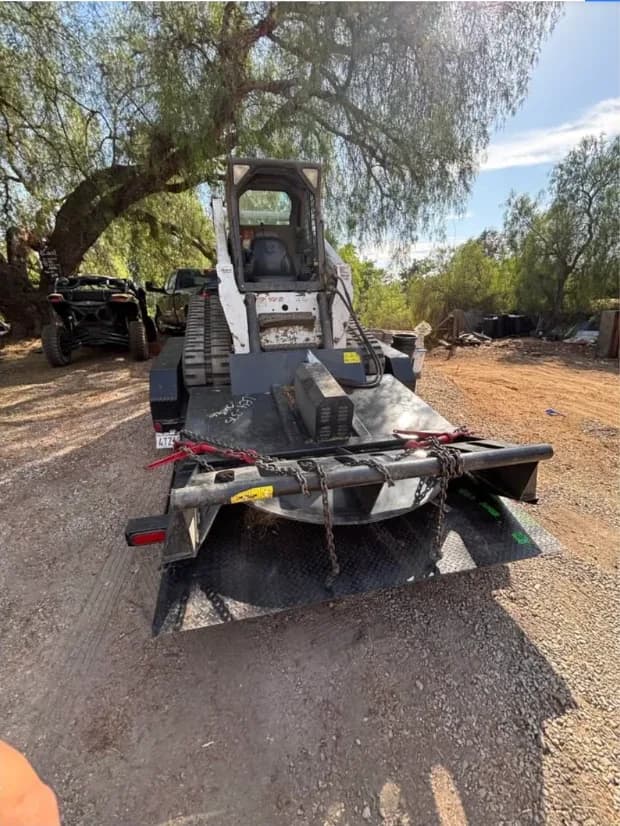
We spread all three with the Bobcat T300 and a general-purpose bucket, then track-roll the surface so it locks down. In a 4-hour minimum ($600) the T300 moves and places roughly 40 to 60 tons on normal ground, so a single 20-ton delivery fits inside the minimum, and a 300-foot driveway regraded and topped with about 40 tons of base is about 6 hours.
The order of work matters more than the machine. We regrade and crown the dirt first, because base laid over ruts copies the ruts. Base goes down damp, since dry base will not knit, and in lifts no thicker than about 3 to 4 inches so the rolling reaches the bottom. On long roads, or where a plan calls for it, we arrange a vibratory roller. Have the trucks drop the material the day before so the machine is spreading, not waiting. Details on the driveway and road grading service.
Questions people ask
Can I put decomposed granite on top of road base?
Yes, and it is a good way to get the DG look on a driveway. Compacted road base carries the load and holds the crown; an inch or two of DG on top gives the color. It still dusts and still washes on a slope, so it suits flat, short driveways near the house, not a climbing ranch road.
Is road base the same as Class II base?
Usually. Class II aggregate base is a specification for crushed rock graded from coarse stone down to fines, and it is what people usually mean by road base. Yards also sell recycled base crushed from concrete. If an engineer's plan calls for Class II, order Class II by name and keep the yard ticket.
Why does my DG driveway turn to mud in winter?
Plain DG is mostly fine particles with little coarse rock, so when it is saturated it loses strength and tires push it around. Fallbrook's native DG does the same, which is why unbased driveways turn to soup in a February storm. A crown and side ditches help; switching the driving surface to compacted road base fixes it.
Does gravel keep the dust down better than DG?
Yes. Clean 3/4-inch gravel has almost no fines, so there is little to blow around, while DG is mostly fines and dusts every dry summer. The trade-off is that gravel never packs. A thin gravel dressing over compacted road base cuts dust and mud near the house; on its own, on a slope or soft dirt, it rolls and ruts.
Should I put fabric under gravel or road base?
On firm decomposed granite, usually not; the base locks onto the graded DG. On soft clay or ground that stays wet, a woven separation fabric under the base keeps the rock from pushing down into the mud. In a drainage area or a French drain, filter fabric keeps the fines out of the gravel. We tell you which applies after seeing the ground.
How much does it cost to spread road base on a driveway?
Spreading is $150 per hour with a 4-hour minimum, and about 20 tons, a common single delivery, fits inside that $600 minimum. The base runs roughly $25 to $45 a ton delivered. A 300-foot driveway regraded and topped with 3 inches of base, roughly 38 to 42 tons, comes to about $1,850 to $2,800 all in.
How these numbers are worked out. Labor is our published rate, $150 per hour with a 4-hour minimum, times the hours these jobs typically take on normal ground. Material prices are typical delivered prices from North County yards and change with the yard and the distance. For a number on your job, text photos to (442) 271-2748 or send the estimate form.