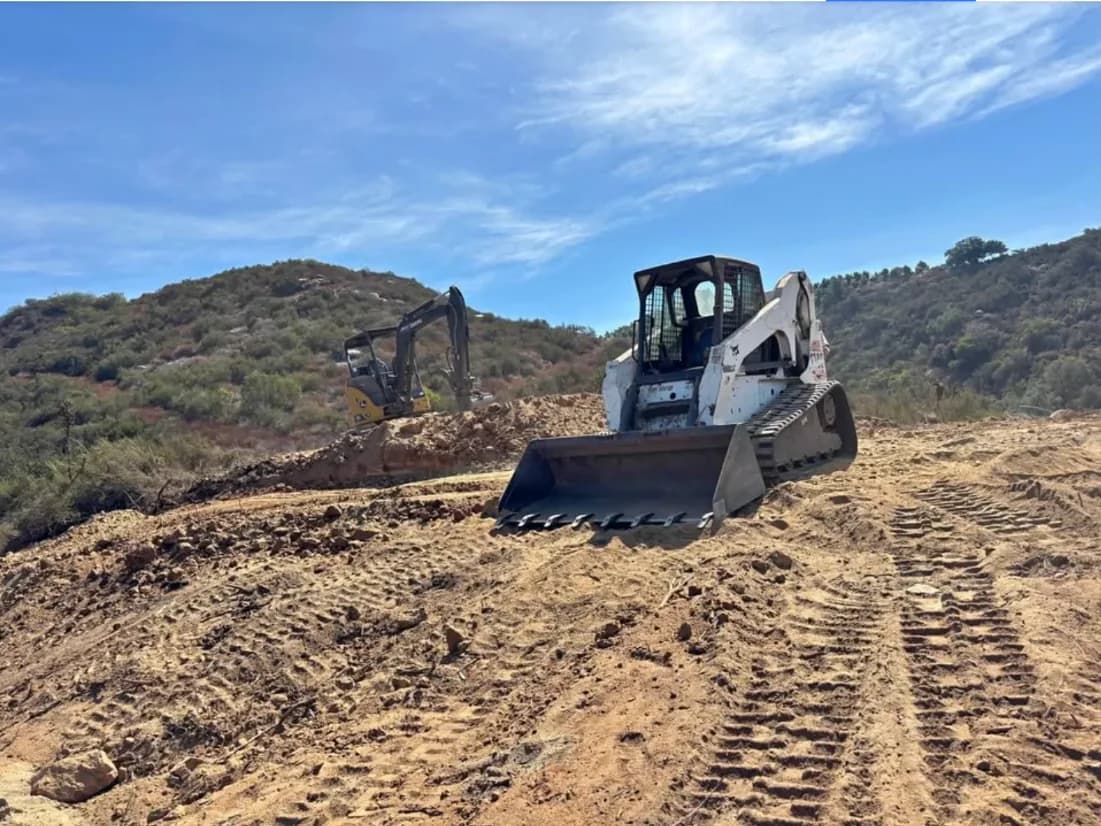
SoCal Dirt Movers, Fallbrook, CA • Updated
Quick answer
Grading a dirt driveway in Fallbrook and North San Diego County costs $600 for a regrade and crown on a driveway up to about 300 feet, the 4-hour minimum at $150 per hour. Adding 3 inches of road base to a 300-foot driveway brings it to roughly $1,850 to $2,800. A quarter mile of shared private road runs $900 to $1,500 before base.
At a glance
- Regrade and crown, up to 300 ft
- 4 hours, $600
- 3 in of base, 300 x 10 ft
- About 28 cubic yards, 38 to 42 tons
- Road base delivered
- $25 to $45 per ton
- 300 ft with base, all in
- About $1,850 to $2,800
- Quarter mile shared road
- 6 to 10 hours, $900 to $1,500 before base
- How often
- Yearly on bare dirt, every 2 to 4 years with base
How much does it cost to grade a dirt driveway?
Regrading and crowning a dirt driveway up to about 300 feet long costs $600, the 4-hour minimum at $150 per hour, operator and fuel included. Road base is the bigger number: at 3 inches deep it usually costs more than the grading. The table assumes a driveway 10 feet wide on normal Fallbrook ground.
| Length | Regrade and crown only | Base at 3 in | Hours with base | Labor plus base |
|---|---|---|---|---|
| 100 ft | 4 hours, $600 | 9 yd, 13 to 14 tons | 4 | $925 to $1,230 |
| 200 ft | 4 hours, $600 | 18.5 yd, 26 to 28 tons | 4 to 5 | $1,250 to $2,010 |
| 300 ft | 4 hours, $600 | 28 yd, 38 to 42 tons | 6 | $1,850 to $2,800 |
| 500 ft | 4 to 6 hours, $600 to $900 | 46 yd, 65 to 70 tons | 8 to 10 | $2,825 to $4,650 |
| Quarter mile (1,320 ft) | 6 to 10 hours with ditches, $900 to $1,500 | 122 yd, 170 to 185 tons | 16 to 24 | $6,650 to $11,925 |
A 12-foot driveway needs 20 percent more base than a 10-foot one. Rock, steep pitches and washouts add hours; see our driveway and road grading service for typical jobs.
How much road base does a driveway need?
A 3-inch lift of road base takes about 1 cubic yard, roughly 1.4 to 1.5 tons, for every 108 square feet of driveway. The formula: length x width x depth in feet, divided by 27 for cubic yards, times 1.4 to 1.5 for tons.
For a 300-foot driveway 10 feet wide: 300 x 10 x 0.25 = 750 cubic feet. Divided by 27, that is about 28 cubic yards, or roughly 38 to 42 tons. Add 15 to 25 percent for compaction and waste and the order is about 44 to 52 tons, which is 3 to 4 loads on a 10-wheel dump truck carrying 14 to 16 tons each. A small leftover pile is not wasted: it is next winter's pothole patch.
Measure turnarounds and parking pads separately. The same math for any shape is in how much fill dirt or base to order.
Is regrading enough, or do I need road base?
Regrading alone is enough on a short, fairly flat driveway with light traffic, if you grade it once a year. A graded dirt road holds up for about a season; with 3 to 4 inches of compacted road base it holds up for years, because the crushed rock locks together and sheds water.
On Fallbrook's decomposed granite the difference shows by February. Bare DG crowned in the fall ruts in the first big storm and dries to washboard by summer. With base, the crown survives and water reaches the edges before it can cut. Base pays off on driveways that climb, carry trucks or horse trailers, or serve more than one house. See road base vs DG vs gravel for the material choice.
What do water bars and washout repairs add?
Cutting water bars and ditches on a steep driveway is 4 to 6 hours, $600 to $900, as its own job, and about 2 to 4 more hours added to a regrade. A water bar is a shallow diagonal ditch cut across the road every 50 to 100 feet that kicks runoff to the side before it builds speed. On the steep grove roads up De Luz Road and along Rainbow Valley Boulevard, they decide whether a road lasts the winter.
A storm washout is 4 to 8 hours, $600 to $1,200, plus material. We dig out the loose material, rebuild the roadbed in compacted lifts, set rip-rap or a small culvert where the water crosses, and regrade the approach. Washouts move to the front of the schedule in January and February.
How often should a dirt driveway be graded, and when?
Grade a bare dirt driveway once a year, after the rainy season, and a driveway with compacted base every 2 to 4 years. Ditches and water bars matter more than the surface: a road that drains stays graded.
Timing matters on decomposed granite. DG grades beautifully when damp and turns to dust when dry, so the ideal window is a few days after a rain, once the surface is firm. In Valley Center and across our area that usually means March, after the last storm. A saturated road ruts; a dry one leaves loose dust that washes off in the first rain. In a dry summer we put water down ahead of the machine.
On roads that wash out every year, add a fall grading so the crown, ditches and water bars are in place before the first storm.
Do I need a permit to grade my driveway?
Not to regrade an existing dirt driveway in unincorporated San Diego County. The County Grading Ordinance (Section 87.202) exempts routine road maintenance: smoothing, texturing, and filling small rills and potholes within the existing road footprint, with no change to the landform. A yearly regrade and crown fits that description.
A new driveway is different. Cutting a new route or widening into a hillside is grading, and the County generally requires a grading permit when excavation or fill moves more than 200 cubic yards, when a cut or fill is more than 8 feet high, or when the work alters land within a watercourse, affects its flow or capacity, or places fill in a mapped floodway. A new 100-foot gravel driveway on gentle ground (6 to 10 hours) usually stays well under 200 cubic yards; a long driveway cut into a slope may not, and a culvert in a creek can trip the watercourse rule.
Exempt work still has to meet the ordinance's slope, setback, erosion prevention and planting requirements. We do not pull permits; we say when a job looks like it needs one and grade to the approved plan. The County PDS Land Development Counter is (858) 694-2055. In the Riverside County part of De Luz, Riverside County Building and Safety is the authority. More in our San Diego County grading permit guide.
What does a typical driveway job cost, start to finish?
Three typical examples, worked out the way the quote is written. Material ranges are wide because yard prices and distances vary.
- 1
300-foot driveway with 3 inches of base: about $1,850 to $2,800
300 x 10 x 0.25 = 750 cubic feet, about 28 cubic yards, roughly 38 to 42 tons. At $25 to $45 a ton delivered, the base is about $950 to $1,900. Regrading plus spreading is 6 hours, $900. Total about $1,850 to $2,800. Ordering the full 15 to 25 percent extra adds roughly 6 to 10 tons, $150 to $450 more.
- 2
Steep 500-foot grove road with water bars: about $900 to $1,500
Regrade and crown 500 feet, 4 to 6 hours. Cut a water bar every 50 to 100 feet, 5 to 10 of them, and open the ditches they drain into, about 2 to 4 more hours on the same visit. Total 6 to 10 hours at $150: $900 to $1,500. No material.
- 3
Quarter-mile shared road, six households: $150 to $250 each
Regrade, crown and ditch 1,320 feet in 6 to 10 hours, $900 to $1,500 for the whole road. Split evenly six ways, that is $150 to $250 per household, once a year.
Questions people ask
How many truckloads of road base does a 300-foot driveway need?
Three to four 10-wheel dump truck loads. A 300-foot driveway 10 feet wide needs about 28 cubic yards for a 3-inch lift, roughly 38 to 42 tons, and a 10-wheel truck carries about 14 to 16 tons. Adding the 15 to 25 percent extra for compaction and waste brings the order to about 44 to 52 tons.
Why does my dirt driveway turn to washboard?
Tires bouncing over a dry, loose surface push the fines into ripples, and it gets worse wherever water has stripped the crown. Decomposed granite does it every Fallbrook summer. Regrading cuts the ripples off and rebuilds the crown, but compacted road base is what keeps them from coming back, because the crushed rock locks together instead of shifting.
Can you grade a dirt driveway in the middle of summer?
Yes, but dry DG does not compact; it turns to dust that blows or washes away. In summer we put water down ahead of the machine so the surface knits back together. The cheapest window is a few days after a rain, when the ground is damp but firm, plus a fall grading on roads that wash every year.
How long does a graded dirt driveway last?
A bare dirt driveway regraded and crowned usually lasts one rainy season before the ruts and washboard come back. With 3 to 4 inches of compacted road base it goes 2 to 4 years between gradings. Working ditches and water bars stretch both numbers, because most damage comes from water running down the road, not from cars.
Do I need a culvert where my driveway crosses a wash?
If water crosses the driveway in every storm, usually yes, or a rock-lined dip that lets it cross without cutting the road. We set small culverts and rip-rap with the excavator. If the wash is a mapped creek, or the work changes its flow or capacity, the County generally requires a grading permit, so check with Planning and Development Services first.
Is it cheaper to grade every year or to put down road base?
Over five years the money comes out close. Five yearly regrades of a 300-foot driveway cost about $3,000. Base costs about $1,850 to $2,800 up front, then a $600 regrade every 2 to 4 years: roughly $2,450 to $4,000 over five years. What base buys is a road that stays firm through the wet months, which matters most on driveways that climb.
Sources
- County of San Diego PDS, Grading Plan Application User Guide
- County of San Diego Planning and Development Services
Rules change. Check with the agency before you rely on a deadline or a threshold.
How these numbers are worked out. Labor is our published rate, $150 per hour with a 4-hour minimum, times the hours these jobs typically take on normal ground. Material prices are typical delivered prices from North County yards and change with the yard and the distance. For a number on your job, text photos to (442) 271-2748 or send the estimate form.