SoCal Dirt Movers, Fallbrook, CA • Updated
Quick answer
To find how much fill dirt you need, multiply length by width by depth in feet and divide by 27 for cubic yards, then add 15 to 25 percent for compaction and waste. Fill dirt weighs roughly 1.2 to 1.4 tons per yard; road base, DG and gravel 1.4 to 1.5. In North San Diego County, clean fill runs $15 to $35 a yard delivered.
At a glance
- Formula
- Length x width x depth (ft) / 27 = cubic yards
- Extra to order
- 15 to 25 percent for compaction and waste
- Fill dirt weight
- Roughly 1.2 to 1.4 tons per cubic yard
- Road base, DG, gravel weight
- Roughly 1.4 to 1.5 tons per cubic yard
- Clean fill, delivered
- $15 to $35 a cubic yard
- Road base, DG, gravel, delivered
- $25 to $45 a ton
How do I calculate how much fill dirt I need?
Multiply the length by the width by the depth, all in feet, and divide by 27 to get cubic yards. There are 27 cubic feet in a cubic yard, which is why the 27 is there. The same formula works for fill dirt, road base, decomposed granite and gravel.
- 1
Measure the area
Length and width in feet. Break odd shapes into rectangles and add them up. For a circle, multiply 3.14 by the radius squared.
- 2
Convert the depth to feet
Divide inches by 12: 2 inches is 0.17 ft, 3 inches 0.25, 4 inches 0.33, 6 inches 0.5. If the depth varies, measure in several spots and average them.
- 3
Multiply and divide by 27
A 20 x 30 ft area filled 6 inches deep is 20 x 30 x 0.5 = 300 cubic feet. Divided by 27, that is 11.1 cubic yards.
- 4
Add 15 to 25 percent
11.1 yards becomes about 13 to 14 yards to order, which covers compaction and the waste at the edges.
How much material do common jobs need?
The jobs we see most need anywhere from about 3 to 60 cubic yards. The table works the formula for the jobs we see most, with the extra already added in the last two columns.
| Job | Area and depth | Yards in place | Yards to order (plus 15 to 25%) | Roughly tons to order |
|---|---|---|---|---|
| Base under a 12 x 20 ft shed pad | 240 sq ft, 4 in | 3.0 | 3.4 to 3.7 | 5 to 6 |
| DG path, 3 x 100 ft | 300 sq ft, 3 in | 2.8 | 3.2 to 3.5 | 4.5 to 5 |
| Gravel RV pad, 12 x 40 ft | 480 sq ft, 4 in | 5.9 | 6.8 to 7.4 | 9.5 to 11 |
| Road base on a 300 x 10 ft driveway | 3,000 sq ft, 3 in | 27.8 | 32 to 35 | 45 to 52 |
| Fill a low corner of a yard | 1,000 sq ft, 6 in | 18.5 | 21 to 23 | 26 to 32 |
| Raise a whole backyard | 2,000 sq ft, 4 in | 24.7 | 28 to 31 | 34 to 43 |
| Build up a building pad | 1,200 sq ft, 12 in | 44.4 | 51 to 56 | 61 to 78 |
| Base on a 100 x 200 ft arena, per inch | 20,000 sq ft, 1 in | 61.7 | 71 to 77 | 99 to 116 |
How do I convert cubic yards to tons?
Multiply cubic yards by the material's weight per yard: roughly 1.2 to 1.4 tons for fill dirt and 1.4 to 1.5 tons for road base, DG and gravel. To go the other way, divide tons by the same number. It matters because yards usually sell fill by the yard and rock products by the ton.
For example, 20 tons of road base is about 13.3 to 14.3 cubic yards. At 3 inches deep that covers roughly 1,440 to 1,540 sq ft loose, or about 1,150 to 1,340 sq ft once you allow for compaction. Wet material weighs more, so a load delivered after rain covers a little less per ton. Which product to use on a driveway is its own question, answered in road base vs DG vs gravel.
Why order 15 to 25 percent extra?
Because loose material packs down when it is compacted, and running short costs more than a little extra. Fill placed in lifts and track-rolled ends up thinner than it went down, the ground underneath is never perfectly even, and some material is lost at the edges.
Use the low end for a thin layer of base on firm ground and the high end for deep fill that will be compacted in lifts. A second delivery for the last 2 yards often costs nearly as much as the first truck, and the machine waiting for it is billed time. Leftover fill is easy to use in a low corner; a shortfall is not.
How many truckloads is that?
A standard 10-wheel dump truck carries about 10 to 12 cubic yards, so divide your order by 10 to 12 for the number of loads. Smaller jobs fit a dump trailer behind a pickup; big imports go faster in a super dump or a truck and transfer.
| Truck | Carries | Typical use |
|---|---|---|
| Dump trailer behind a pickup | 3 to 5 cubic yards | Shed pad base, a DG path, a small low spot |
| 10-wheel dump truck | 10 to 12 cubic yards, about 14 to 16 tons of dirt | Driveway base, yard fill |
| Super dump or truck and transfer | 18 to 24 cubic yards | Pad import, long driveways, arenas |
Rock products are heavier than dirt, so count base, DG and gravel by the tons on the yard's ticket and ask the yard what one of its trucks carries. A 21 to 23 yard fill order is two 10-wheel loads; a 51 to 56 yard pad import is five or six.
What does fill dirt, road base or gravel cost?
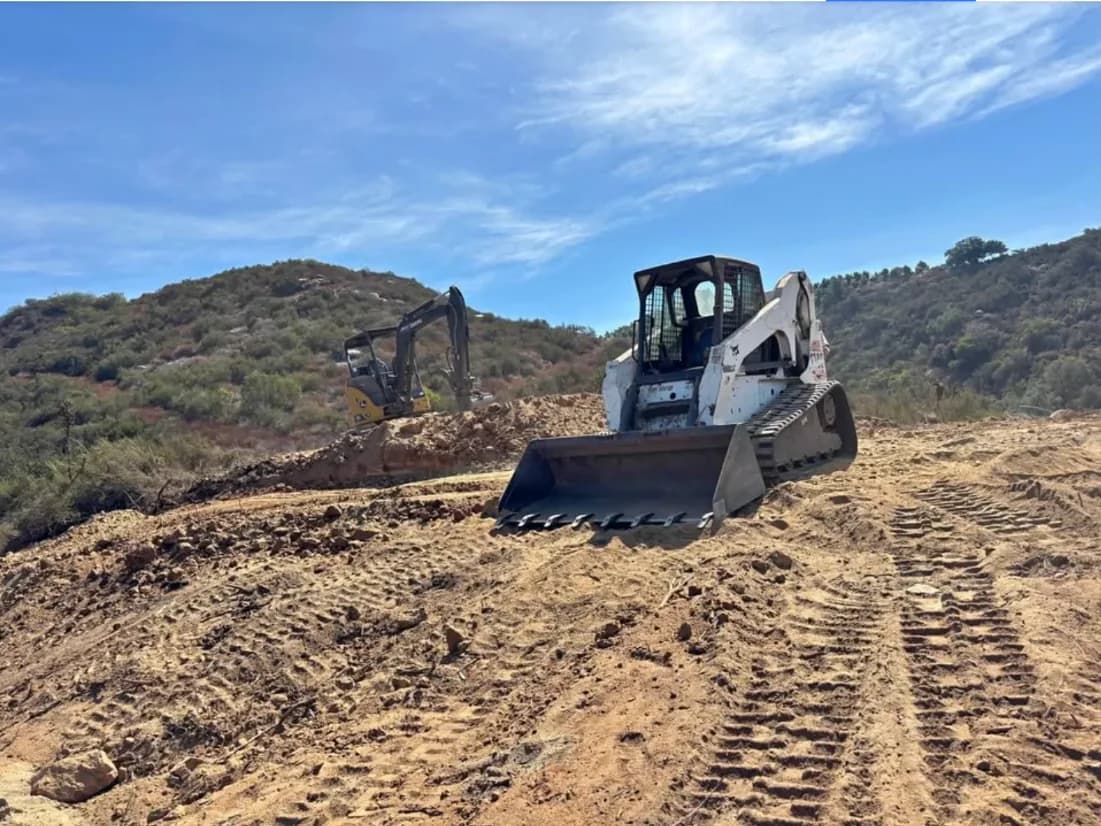
In North San Diego County, clean fill generally runs $15 to $35 a cubic yard delivered and road base, DG and gravel $25 to $45 a ton, depending on the yard and the distance. Spreading it is machine time at $150 per hour with a 4-hour minimum, and the Bobcat T300 moves and places roughly 40 to 60 tons in that minimum on normal ground. Four typical examples:
- 1
Low corner of a yard: about $915 to $1,555
1,000 sq ft filled 6 inches is 18.5 yards, so 21 to 23 yards ordered. At $15 to $35 a yard that is $315 to $805. Spreading 26 to 32 tons, blending it into the yard and track-rolling it is 4 to 5 hours, $600 to $750.
- 2
Road base on a 300 ft driveway: about $2,025 to $3,060
300 x 10 ft at 3 inches is about 28 cubic yards, roughly 38 to 42 tons in place. With 15 percent extra, order 45 to 48 tons: $1,125 to $2,160 at $25 to $45 a ton. Regrading and spreading is about 6 hours, $900.
- 3
Building pad import: about $1,590 to $3,160
1,200 sq ft raised 1 foot is 44.4 yards; with 25 percent extra for fill compacted in lifts, about 56 yards, roughly 67 to 78 tons. Fill at $15 to $35 a yard is $840 to $1,960. Placing it in lifts takes 5 to 8 hours, $750 to $1,200.
- 4
Shed pad base: about $725 to $870
12 x 20 ft at 4 inches is 3 yards, about 5 to 6 tons to order: $125 to $270 of base. Leveling the pad and spreading the base is the $600 minimum. Ask the yard about a minimum delivery charge on a small load.
If the whole job is a yard or two of soil in an open front yard, a wheelbarrow is cheaper than a 4-hour minimum. Above that, the machine wins. Our pricing page lists typical hours for every service.
Where does fill dirt come from?
Fill comes from material yards in Fallbrook, Bonsall and the Temecula valley, or from a nearby job that needs to export, which is the cheapest dirt there is. We tell you the yards your job needs after the site walk, then order the trucks or give you the yard's number.
Ask for clean fill: no trash, roots, concrete or big rock. Topsoil is for planting and settles as it breaks down, so it does not belong under a slab or a driveway. If the fill goes under a building or a slab, ask your soils engineer what fill is acceptable before it is delivered. Spreading and placement are covered on our dirt moving and material spreading page.
When does the cut on my own lot supply the fill?
On most hillside lots in Fallbrook, Bonsall and Valley Center the cut supplies the fill: dirt cut from the uphill side of a pad is pushed downhill to build out the other side, and no material is bought. The decomposed granite that comes out of a Fallbrook cut makes good fill.
You need import when the ground has to come up rather than be reshaped: a flat lot below the street, a low corner, a pad on a downhill lot. Dug soil loosens and then packs back down when compacted, so a cut does not always fill exactly its own volume, and we check the balance on the site walk. Export costs more than import, so extra dirt goes into a berm, a raised bed or a driveway shoulder first. See what lot grading costs.
Questions people ask
How many square feet does a cubic yard of dirt cover?
One cubic yard covers 324 sq ft at 1 inch deep, 162 sq ft at 2 inches, 108 sq ft at 3 inches, 81 sq ft at 4 inches, 54 sq ft at 6 inches and 27 sq ft at 12 inches. Those are loose numbers before compaction, so add 15 to 25 percent to the order to finish at the depth you want.
Is a yard of dirt the same as a ton?
No. A cubic yard is volume and a ton is weight. A cubic yard of fill dirt weighs roughly 1.2 to 1.4 tons, and a cubic yard of road base, DG or gravel roughly 1.4 to 1.5 tons. Material yards often sell fill by the yard and rock by the ton, so convert before comparing prices.
How many tons of gravel do I need for a 100-foot driveway?
A 100 ft driveway 10 ft wide at 3 inches is 9.3 cubic yards. Add 15 to 25 percent and multiply by roughly 1.4 to 1.5 tons per yard, and you need about 15 to 17 tons, roughly $375 to $765 delivered at $25 to $45 a ton. A wider drive or a 4-inch layer scales up in proportion.
What is the difference between fill dirt and topsoil?
Fill dirt is subsoil with little organic matter, so it compacts and stays put. It is what goes under pads, driveways and low spots. Topsoil is rich in organic matter for planting and settles as that breaks down, so it belongs in the top few inches of a garden or lawn, never under a structure or a driveway.
How much does it cost to have fill dirt delivered and spread?
For a typical 20-yard order, clean fill at $15 to $35 a yard is $300 to $700 delivered. That is roughly 24 to 28 tons, which the Bobcat T300 spreads and track-rolls inside the 4-hour minimum, $600. So about $900 to $1,300 in all, plus a travel charge outside Fallbrook, Bonsall, Rainbow, De Luz, Pala and Valley Center.
How these numbers are worked out. Labor is our published rate, $150 per hour with a 4-hour minimum, times the hours these jobs typically take on normal ground. Material prices are typical delivered prices from North County yards and change with the yard and the distance. For a number on your job, text photos to (442) 271-2748 or send the estimate form.