SoCal Dirt Movers, Fallbrook, CA • Updated
Quick answer
Stopping hillside erosion in Fallbrook and North San Diego County means catching water at the top, easing the slope and armoring the toe, at about $600 to $1,800 per fix at $150 per hour. A swale takes 4 to 6 hours, a dry creek bed 6 to 10, and rebuilding a slid slope 6 to 12. Rock and fabric are extra. Book it in the fall.
At a glance
- First fix
- Swale at the top, 4 to 6 hours ($600 to $900)
- Slope repair
- 6 to 12 hours ($900 to $1,800) plus rock
- Dry creek bed
- 6 to 10 hours ($900 to $1,500) plus rock
- Water bars on roads
- Every 50 to 100 ft on steep runs
- When
- Fall, before the first winter storm
- Call an engineer
- When the slope threatens a structure
How do you stop hillside erosion?
You stop hillside erosion by controlling the water, not by fighting the dirt. Almost every eroding slope in Fallbrook has water arriving at the top from a roof, a driveway, a pad or the slope above, running down the face and cutting at the toe. Take that water away at the top, give the slope an angle it can hold, armor the toe and cover the face. Every one of those is on our drainage and erosion control service.
Work from the top down. Rip-rap at the bottom of a slope that still takes a sheet of roof water at the top only moves the gully sideways.
How do I find out why my slope is eroding?
Walk the slope yourself, ideally during or just after a rain. Twenty minutes with a phone camera tells you most of what an operator needs to quote it.
- 1
Start at the top
Find every source of water reaching the slope: downspouts, a pad or patio edge, a driveway draining toward the edge, a neighbor's slope above. Note any cracks running parallel to the top edge.
- 2
Follow the water down
Look for rills, the small channels a storm cuts in bare DG, and the gullies where they join. The deepest gully usually sits below the biggest water source.
- 3
Check the toe
Look for undercutting, fans of silt and sand, bulging ground, or wet spots that stay wet days after the rain. Bulging and seeps mean the problem is deeper than surface erosion.
- 4
Note what is near
Measure how far the top and the toe sit from the house, a wall, a pool, a driveway or a septic field. If a structure is within reach of a slope that is moving, the next call is a geotechnical engineer.
- 5
Look for a watercourse
If water runs in a defined channel through the property, even only in storms, or the slope drops into a creek, note it. Work in a watercourse is where County grading permits come in.
- 6
Send photos
Text 3 or 4 photos with something for scale, showing the top, the face, the toe and where the water comes from, or send them through the contact page. For most slopes that is enough for a same-day range of hours; bigger jobs get a free site walk.
What does a swale at the top of the slope do?
A swale at the top catches water before it reaches the slope and walks it around to a safe outlet, and it is usually the cheapest effective fix on the property. It is a shallow, rounded channel cut along the top with a gentle fall toward a rock outfall, a dry creek bed or a drain. A 150-foot swale is 4 to 6 hours, $600 to $900, and needs no material.
Downspouts that dump onto the slope belong in solid pipe to the same outlet. Trenching downspout lines to daylight is about 4 hours and can share the visit.
Should the slope be regraded to a gentler angle?
Yes, where there is room. A steeper slope sheds water faster and gives the soil less to hold onto. The cut slopes behind houses on Reche Road, Via Monserate and the Bonsall ridges were often left at about 2:1, two feet across for every foot up, and a 2:1 DG cut can hold for years and then let go in one storm. Laying it back where the lot allows is the most permanent fix there is.
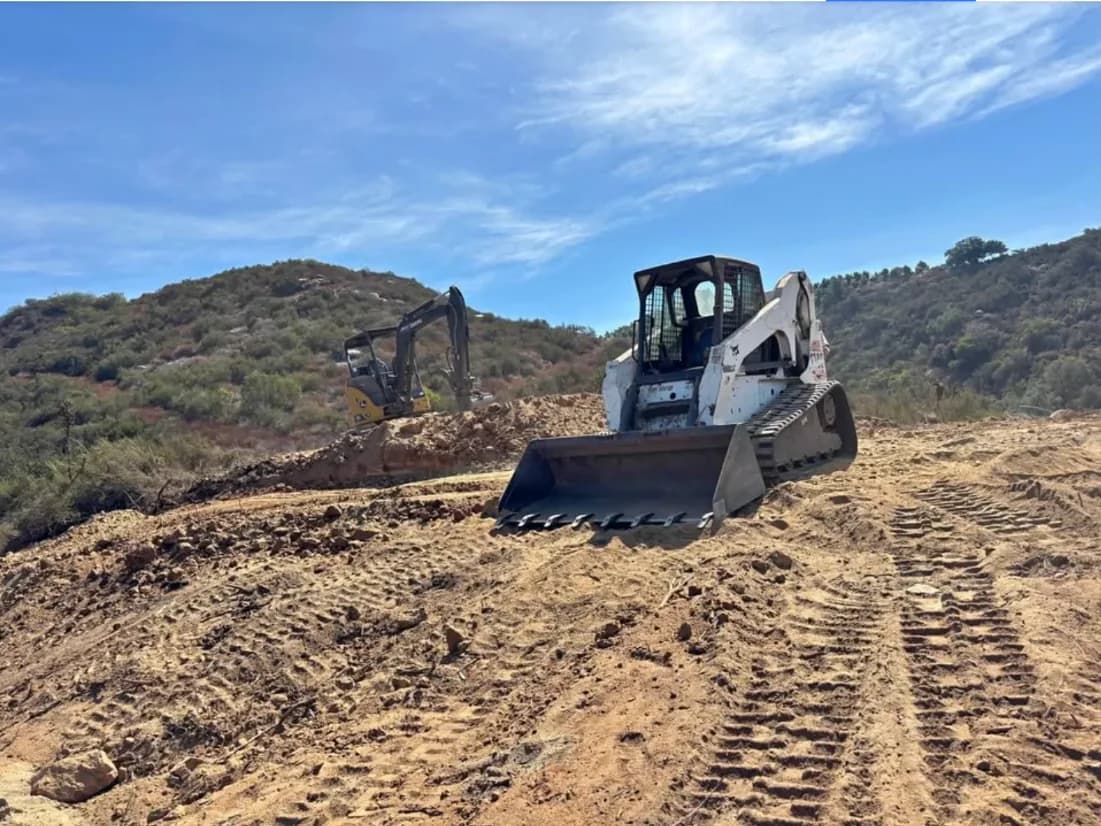
We clean out the slid material, rebuild the slope in compacted lifts with the Bobcat, track-roll the face and re-cut the angle: 6 to 12 hours, $900 to $1,800, plus rock, for most residential slopes. Where there is no room to lay the slope back, the choices are armoring it or a retaining wall, which needs a designer and often an engineer.
What goes at the toe: rip-rap or erosion fabric?
Rip-rap goes where water concentrates and hits hard; erosion fabric goes where soil needs holding until plants take over. Rip-rap is large, angular rock at the toe, at outlets and in channels, set one rock at a time with the excavator's thumb. Erosion control fabric, a biodegradable blanket of straw or coir netting pinned over bare soil, shields the face from raindrops and sheet flow while roots establish.
Many Fallbrook slopes need both: fabric on the face, rip-rap at the toe and at every swale outlet. In Valley Center and north toward Rainbow, the granite boulders that come out of the ground often become the rip-rap.
When do a dry creek bed or water bars make sense?
A dry creek bed makes sense where water already runs in a channel across the property in every storm; water bars make sense on any dirt road or path that runs down a slope. A dry creek bed is a shaped channel lined with rock, cobble and boulders that carries a seasonal wash without cutting, and it reads as landscaping in the dry months. Building one is 6 to 10 hours, $900 to $1,500, plus rock.
Water bars are shallow diagonal ditches cut across a road every 50 to 100 feet on steep runs, each one kicking runoff off the road before it builds speed. Cutting water bars and ditches on a steep grove road is 4 to 6 hours. A road without them becomes a gully that feeds the slope below; see what dirt driveway grading costs.
How much does hillside erosion control cost?
Most erosion fixes are 4 to 12 hours of machine time at $150 per hour, plus rock, fabric or pipe at cost. Several fixes on the same visit share one 4-hour minimum.
| Fix | Typical hours | Labor | Material |
|---|---|---|---|
| Swale at the top of a slope, 150 ft | 4 to 6 | $600 to $900 | None, or rock at the outlet |
| Downspout lines to daylight | 4 | $600 | Solid pipe |
| Regrade a yard that drains toward the slope or house | 4 to 8 | $600 to $1,200 | Usually none |
| Water bars and ditches on a steep road | 4 to 6 | $600 to $900 | None |
| Dry creek bed with rip-rap | 6 to 10 | $900 to $1,500 | Rock and cobble |
| Rebuild a slid slope, rip-rap or fabric at the toe | 6 to 12 | $900 to $1,800 | Rip-rap, fabric |
| French drain for a wet toe, 100 ft | 4 to 6 | $600 to $900 | $300 to $500 |
Planting is the last step, and it is not ours: a landscaper or the homeowner seeds or plants deep-rooted ground cover once the grading is done. In the State Responsibility Area, pick plants that also fit the defensible space rules.
When do I need a geotechnical engineer or a permit?
Call a geotechnical engineer before any machine work when a slope threatens a structure: cracks above a house or below a foundation, a slide that has reached a wall, pool or septic field, or ground that keeps moving after the rain stops. We build to the engineer's plan; we do not do engineering.
The County of San Diego generally requires a grading permit when excavation or fill moves more than 200 cubic yards, when a cut or fill is more than 8 feet high, or when grading alters land within a watercourse, affects a watercourse's flow or capacity, or places fill in a mapped floodway. That last trigger is the one erosion work runs into: a dry creek bed in a natural wash, rip-rap in a bank along Live Oak Creek, or a berm near the San Luis Rey River in Bonsall. Emergency grading is exempt when the County authorizes it in advance in writing, and exempt work still has to meet the ordinance's slope, setback, erosion prevention and planting requirements.
We do not pull permits. Ask the County PDS Land Development Counter, (858) 694-2055, before work in or near a creek, and see our grading permit guide.
When is the right time to do erosion work?
Fall, before the first storm. Fallbrook gets most of its rain in a few winter storms, and the work that matters, swales, water bars and toe protection, has to be in the ground before that water arrives. Fabric and seed put down in the fall also get the winter rain to establish. January and February are for repairs, when slides and washouts jump the schedule.
Questions people ask
Will plants alone stop a slope from eroding?
Not while water is still pouring over the top. Roots hold the surface soil, but they cannot stop a concentrated stream from a downspout or a driveway from cutting a gully, and new plants need a season or two to root. Fix the water first with a swale or pipe, cover the bare soil with erosion fabric, then plant.
Is it too late to fix erosion once the rain has started?
No, but it is harder. Wet DG can be too soft to work without rutting, and a moving slope should be left alone until an engineer looks at it. Between storms we cut swales, clear blocked outlets and place rip-rap. Larger regrading waits a few dry days for the ground to firm up.
Does a slope repair need compaction testing?
Not for most residential erosion repairs, which are rebuilt in compacted lifts and track-rolled with the Bobcat. When a geotechnical engineer is involved, or the slope supports a structure, the plan may call for vibratory compaction and testing. We arrange the roller and coordinate testing with your soils engineer, quoted separately before the job.
What is the cheapest way to stop erosion on my slope?
Usually redirecting the water. A downspout piped away from the slope, or a 4 to 6 hour swale along the top, removes the cause, and the gullies below often stop growing. Filling gullies and placing rock without fixing the water source is the expensive way, because the next storm undoes it.
Can you build a retaining wall to hold the slope?
We dig footings to a plan and backfill after inspection, but we do not design walls. A wall holding a slope near a structure needs a designer and often an engineer, and your designer or contractor handles any permit. For most erosion problems a swale, a gentler slope and rock at the toe solve it for less, without a wall.
How do I keep a cleared fire break from eroding?
Mow it rather than scrape it. The brush cutter takes the fuel down and leaves the roots, which keep holding the soil; a steep slope graded to bare dirt grows gullies. Where a cleared path or fire break runs straight downhill, cut water bars across it every 50 to 100 feet before the rain.
Sources
- County of San Diego PDS, Grading Plan Application User Guide
- County of San Diego Planning and Development Services
Rules change. Check with the agency before you rely on a deadline or a threshold.
How these numbers are worked out. Labor is our published rate, $150 per hour with a 4-hour minimum, times the hours these jobs typically take on normal ground. Material prices are typical delivered prices from North County yards and change with the yard and the distance. For a number on your job, text photos to (442) 271-2748 or send the estimate form.