SoCal Dirt Movers, Fallbrook, CA • Updated
Quick answer
Grading an ADU pad in North San Diego County costs about $900 to $1,200 in labor on a flat lot (6 to 8 hours at $150 per hour) and $1,200 to $2,400 for a hillside cut-and-fill pad (8 to 16 hours). Fill dirt, compaction testing and utility trenching to the ADU are extra. The pad itself is usually one to two days of machine time.
At a glance
- Flat-lot ADU pad
- 6 to 8 hours, $900 to $1,200
- Hillside cut-and-fill pad
- 8 to 16 hours, $1,200 to $2,400
- Utility trenching to the ADU
- 6 to 12 hours, $900 to $1,800
- Grading accuracy
- Rough grade to within a few inches of the plan
- Footing excavation
- Exempt from a separate County grading permit under a valid building permit
- Minor grading permit cap
- 2,500 cubic yards, 200 cubic yards of import or export
How much does it cost to grade an ADU pad?
An ADU pad in North San Diego County costs $900 to $1,200 in machine time on a flat lot and up to $2,400 on a hillside, at $150 per hour with a 4-hour minimum, operator and fuel included. The pad is only part of the site work, so the table also shows the footings, trenches and backfill that usually follow it.
| Work | Typical hours | Labor at $150/hour |
|---|---|---|
| Rough-grade a 1,000 to 1,200 sq ft ADU pad on a flat lot | 6 to 8 | $900 to $1,200 |
| Rough-grade an ADU pad on a gently sloped lot | 6 to 12 | $900 to $1,800 |
| Cut and fill an ADU pad into a hillside | 8 to 16 | $1,200 to $2,400 |
| Place and track-roll 10 loads of imported fill | 8 to 12 | $1,200 to $1,800 |
| Dig footings for a 400 sq ft ADU or addition | 6 to 10 | $900 to $1,500 |
| Trench water, sewer and power to the ADU | 6 to 12 | $900 to $1,800 |
| Backfill trenches after inspection, on its own visit | 2 to 4 | $600 (4-hour minimum) |
What does rough grading an ADU pad include?
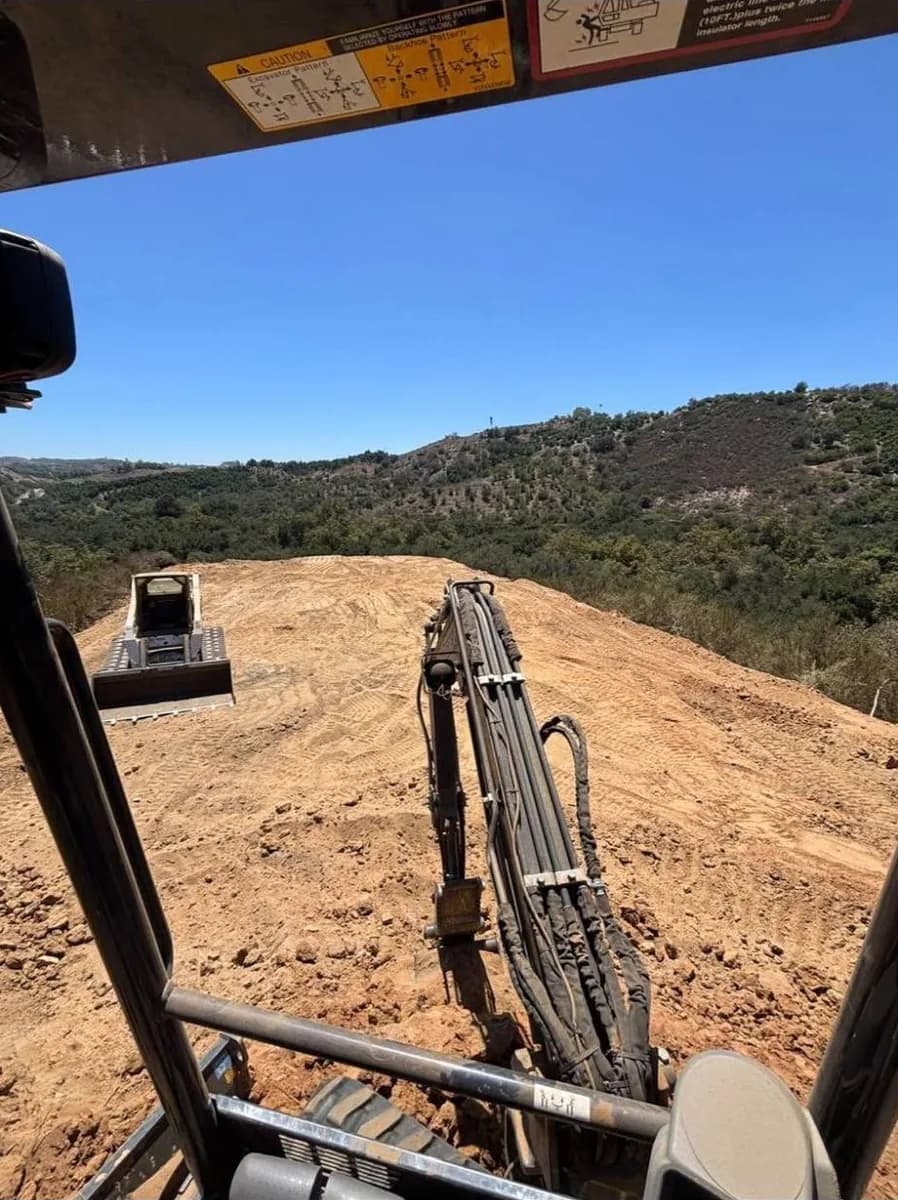
Rough grading means cutting and filling the pad to the elevation on your site plan, within a few inches, so the foundation contractor can fine-grade and set forms without re-cutting it. We set it out with grade stakes and check it with the laser level.
- Pad corners and finished elevation staked from the site plan
- Roots, old grove stumps and loose topsoil taken out of the footprint
- Cut to grade, fill placed in lifts and track-rolled with the Bobcat T300
- The pad shaped so water runs away from it, as the plan shows
- Spoil kept on the lot where the plan allows, or loaded for export at cost
The same crew and machines handle the trenching and footings, so one trailer trip can cover several steps. See grading and leveling for what else a pad can include.
Why does a hillside ADU pad cost more than a flat one?
A hillside pad moves several times more dirt: everything cut from the uphill side is pushed downhill, placed in lifts and compacted to build out the other half of the pad. On a flat lot the machine mostly strips and levels.
In Fallbrook, Bonsall and Valley Center most ADUs go onto old grove slopes. Decomposed granite holds a cut face well, but boulders, stumps and the cut bank itself add excavator time. A tall cut bank may need a retaining wall, which an engineer designs and a wall builder constructs; we dig its footing. On most hillside lots the cut supplies the fill, so no material is bought.
Do I need a grading permit for an ADU pad?
An ADU pad in unincorporated San Diego County needs a grading permit only when it crosses a County threshold: generally more than 200 cubic yards of excavation or fill, a cut or fill more than 8 feet in vertical height, or grading that alters a watercourse or places fill in a mapped floodway. A flat-lot pad is usually well under. A steep hillside pad can approach it.
When a permit applies to grading for a single-family home or accessory structure, it can be a minor grading permit (Grading Ordinance Section 87.206), processed with the building plan check, as long as the job stays inside its limits:
- A single lot, and no more than 2,500 cubic yards of grading
- No more than 200 cubic yards of import or export
- No surface water affected and no new drainage structures
- No cut or fill bank over 20 feet
Excavation below finished grade for footings authorized by a valid building permit is exempt from a separate grading permit (Section 87.202), but exempt work still has to meet the ordinance's slope, setback, erosion prevention and planting requirements. Grading permits also get CEQA review, and the applicant signs an At-Risk letter acknowledging possible discretionary review.
We do not pull permits or do engineering. Your designer or contractor files the plans, and the PDS Land Development Counter is (858) 694-2055. Inside an incorporated city such as Vista, Oceanside, San Marcos or Escondido, that city's building department sets the rules. Our San Diego County grading permit guide goes deeper.
Who handles compaction testing?
Your soils engineer does the testing, and we coordinate with them so each lift of fill is placed and tested in the order their report requires. We place fill in lifts and track-roll it with the Bobcat. When the plan calls for a vibratory roller or compaction testing, both are quoted at cost before the job, so the number you approve already includes them.
Tell us early if a soils report exists. Scheduling the lifts around the tester's visits keeps the machine working instead of waiting, which is billed time.
What order does ADU site work happen in?
ADU site work runs from approved plans to rough grade to footings and utilities, with your foundation contractor setting the final sequence. A typical order:
- 1
Plans and permits
Site plan with the pad elevation, soils report if required, and the building permit issued. Any minor grading permit is processed with the plan check.
- 2
811 ticket
At least 2 working days before digging. 811 does not mark private lines such as a well, septic or power to a barn, so flag those.
- 3
Rough grade the pad
One day on a flat lot, one to two on a hillside, with testing as the fill goes in if the plan calls for it.
- 4
Footings
Dug with the mini excavator to the footing plan, or by the foundation contractor, then inspected.
- 5
Utility trenches
Water, sewer and power to the ADU take 6 to 12 hours. The plumber and electrician set the depths, typically 18 inches for water service and PVC conduit and 24 for direct-burial cable.
- 6
Backfill and fine grade
We backfill trenches in 2 to 4 hours after inspection. The foundation contractor fine-grades, forms and pours.
What do typical ADU pads cost, start to finish?
Three typical examples, worked the way the quote is written. Ground conditions and material prices change the totals, not the arithmetic.
- 1
Flat-lot pad and utilities: about $2,400 to $3,600
A 1,100 sq ft pad, 6 to 8 hours ($900 to $1,200). Trenching water, sewer and power, 6 to 12 hours ($900 to $1,800). Backfill on a separate visit after inspection, the $600 minimum. No material because the lot balances. Total: about $2,400 to $3,600.
- 2
Hillside pad in Bonsall or Valley Center: about $1,800 to $2,400 plus testing
A pad cut into a grove slope, the cut supplying the fill, placed in lifts. Twelve to sixteen hours is $1,800 to $2,400. If the plan calls for a vibratory roller and compaction testing, those are quoted at cost on top.
- 3
Low lot that needs import: about $1,815 to $3,460
A 1,200 sq ft pad raised 1 foot needs 44.4 cubic yards, so 51 to 56 yards ordered with 15 to 25 percent extra: five or six 10-wheel truck loads. At $15 to $35 a yard that is $765 to $1,960. Placing the fill in lifts takes 5 to 8 hours, and finishing the pad to elevation brings it to 7 to 10 hours, $1,050 to $1,500. The import stays well under 200 cubic yards.
What should I have ready before the machine arrives?
Have the plan, the permit, the access and the people lined up, because every one of them missing on the day turns into billed waiting. The checklist:
- Approved plans, or at least the site plan with pad corners and finished elevation
- The permit, if the project needs one, on site
- Your soils engineer's contact and testing schedule, if the plan requires testing
- An 811 ticket, and the locations of any private lines you know of
- A gate opening of about 7 feet for the T300, or a plan for the mini excavator
- A spot on the property for spoil, and fill ordered if the lot needs it
- Your foundation contractor's start date
Questions people ask
Can you dig the ADU footings too?
Yes. Give us the footing plan and the mini excavator digs to its lines and depths so your contractor can set forms and call the inspection. Footings for a 400 sq ft ADU or addition typically take 6 to 10 hours, $900 to $1,500 at $150 per hour. Footing excavation under a valid building permit needs no separate grading permit.
Should I grade the pad before my ADU permit is issued?
We recommend waiting. Pad elevations, setbacks and drainage can change during plan check, and regrading a finished pad means paying for the same hours twice. If the project needs a grading permit, the grading has to wait for it anyway. Send us the plans while they are in review and we will have the hours ready when the permit is.
How much does it cost to trench utilities to an ADU?
Water, sewer and power runs to an ADU usually take 6 to 12 hours of mini excavator time, $900 to $1,800 at $150 per hour. A straightforward utility trench in normal soil works out to roughly $4 to $6 per foot. Backfill after inspection is 2 to 4 hours, or the 4-hour minimum if it is a separate trip.
Will the machines fit in my backyard for an ADU?
The Bobcat T300 needs a gate opening of about 7 feet. The mini excavator fits a narrower opening, and on many lots we take down a fence panel for the day and put it back. Tell us the gate width and the route from the street when you send photos, and we plan the access before the trailer leaves.
Can you remove the old shed or patio where the ADU goes?
Yes. Tearing down a wood or metal shed or breaking out a 400 sq ft patio is typically a four-hour job, and haul-off is quoted at cost. We do not demolish anything with live gas, water or power, or anything with asbestos or lead paint. Bundling the demolition with the pad grading saves a second minimum.
Is ADU pad grading different inside a city like Vista or Escondido?
The machine work is the same, but the rules are not. Incorporated cities such as Vista, Oceanside, San Marcos and Escondido have their own building and grading departments, so their thresholds and processes apply instead of the County's. Those cities also carry a flat travel charge from us, quoted before you book. We grade to whatever plan the city approves.
Sources
- County of San Diego PDS, Grading Plan Application User Guide
- County of San Diego Planning and Development Services
Rules change. Check with the agency before you rely on a deadline or a threshold.
How these numbers are worked out. Labor is our published rate, $150 per hour with a 4-hour minimum, times the hours these jobs typically take on normal ground. Material prices are typical delivered prices from North County yards and change with the yard and the distance. For a number on your job, text photos to (442) 271-2748 or send the estimate form.