SoCal Dirt Movers, Fallbrook, CA • Updated
Quick answer
In Fallbrook and North San Diego County, California Public Resources Code 4291 requires 100 feet of defensible space around buildings, or to the property line if closer. The first 30 feet (Zone 1) must be lean, clean and green. From 30 to 100 feet (Zone 2), grass is cut to 4 inches and shrubs and trees are spaced by slope. Inspections typically happen in spring.
At a glance
- The law
- California Public Resources Code 4291
- Distance
- 100 ft from buildings, or to the property line
- Zone 1 (0 to 30 ft)
- Lean, clean and green: no dead plants, leaves or needles
- Zone 2 (30 to 100 ft)
- Grass 4 in max, shrubs and trees spaced by slope
- Zone 0 (0 to 5 ft)
- Rules approved in 2026; effective date still being finalized
- Who inspects
- North County Fire or Valley Center Fire, plus CAL FIRE
What does California law require around my house?
California Public Resources Code 4291 requires owners of buildings in the State Responsibility Area to keep 100 feet of defensible space around them, or up to the property line if that is closer. Fallbrook, Bonsall, Rainbow and Valley Center are in the State Responsibility Area, so the rule covers homes and outbuildings across those communities.
Defensible space does not mean bare dirt. It means fuel that is reduced, spaced and kept low, so a fire slows down and drops to the ground before it reaches the house, and firefighters have room to work. The area has seen why: the Paradise Fire in Valley Center in 2003, the Rice Fire out of Rainbow in 2007, and the Lilac Fire through Bonsall and Rancho Monserate in December 2017.
What has to be done in Zone 1, the first 30 feet?
Zone 1, from the house out to 30 feet, has to be lean, clean and green: nothing dead and nothing dry piled against the building.
- Remove dead plants, grass and weeds
- Remove dead leaves and needles, on the ground, on the roof and in the gutters
- Keep tree branches at least 10 feet from the chimney
- Remove dead branches that hang over the roof
- Move firewood piles out of Zone 1
Most of Zone 1 is hand work: rakes, pruners and a ladder. Open ground in Zone 1, such as a grass slope below the house, is where a brush cutter helps.
What has to be done in Zone 2, from 30 to 100 feet?
Zone 2, from 30 to 100 feet, is about reducing fuel rather than removing all of it. Annual grass is cut to a maximum of 4 inches, and shrubs and trees are spaced so fire cannot jump from one to the next. Healthy plants can stay; what changes is how much there is and how close together it grows.
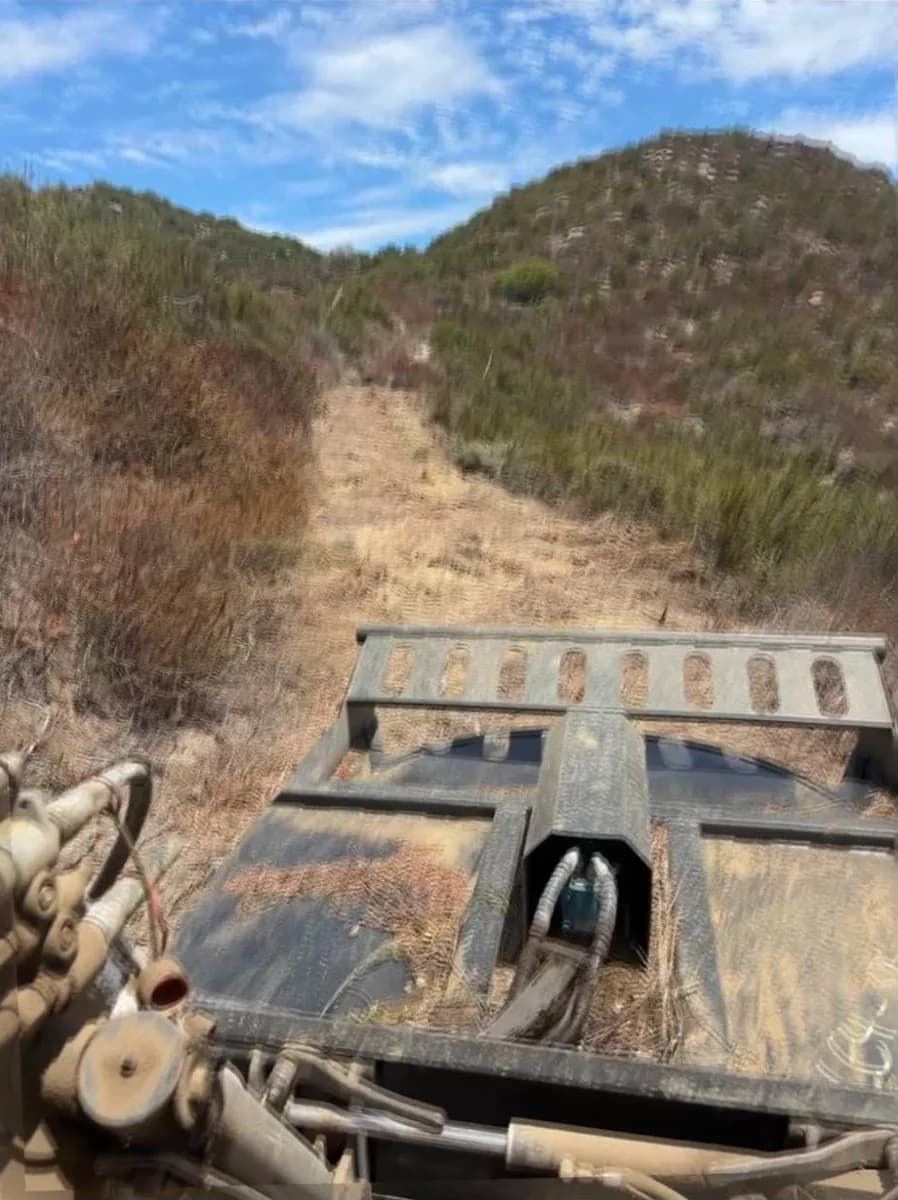
On a Fallbrook or Valley Center hillside, Zone 2 is where most of the work is and where a machine pays off. A brush cutter mows the grass and cuts the chaparral between the plants you keep, on slopes a hand crew would spend days on.
How far apart do shrubs and trees need to be?
Spacing depends on the slope: the steeper the ground, the farther apart the plants, because fire climbs a slope faster. CAL FIRE's horizontal spacing guidance is below. Shrub spacing is a multiple of the shrub's height; tree spacing is measured from canopy edge to canopy edge.
| Slope | Between shrubs | Between tree canopies |
|---|---|---|
| Flat to mild, under 20% | 2 times the shrub's height | 10 ft |
| Mild to moderate, 20% to 40% | 4 times the shrub's height | 20 ft |
| Moderate to steep, over 40% | 6 times the shrub's height | 30 ft |
Vertical spacing matters as much. Remove lower tree branches to at least 6 feet above the ground; on short trees, remove no more than a third of the tree's height. Keep shrubs out from under trees, so a ground fire cannot climb into the canopy.
What is Zone 0, and is it required yet?
Zone 0 is the ember-resistant first 5 feet around a house, and as of late October 2026 its effective date and enforcement were still being finalized. State law added Zone 0 in 2020 (AB 3074). The California Board of Forestry and Fire Protection approved the Zone 0 rules in 2026, with a multi-year phase-in for existing homes.
Check with your fire district before planning around any date. In the meantime, that 5-foot strip is where embers land first, and it is already inside Zone 1: no dead plants, leaves or needles, and no firewood against the wall.
Which fire district covers my property?
North County Fire Protection District covers Fallbrook, Bonsall, Rainbow and the De Luz area, and the Valley Center Fire Protection District serves Valley Center. CAL FIRE also inspects in the State Responsibility Area.
| Community | Agency | Contact |
|---|---|---|
| Fallbrook, Bonsall, Rainbow, De Luz area | North County Fire Protection District | Fire Prevention Bureau, 760-723-2010 |
| Valley Center | Valley Center Fire Protection District | 760-751-7600 |
| State Responsibility Area, including the above | CAL FIRE | Also inspects |
If your parcel sits near a district line, or across the county line in De Luz, call and ask which agency inspects it and what this year's deadline is. Local details are on our Fallbrook and Valley Center pages.
How do inspections and notices work?
Inspections typically happen in spring, and deadlines vary by year, so get this year's date from your district rather than from last year's notice. Properties that fall short typically get a notice to clear by a set date.
In North County Fire's area, a property still not cleared can go to forced abatement. The district's weed abatement page says that process can take 60 to 90 days and that reinspection fees apply. Under its weed abatement ordinance (2000-01), abatement costs become a lien on the property, collected with property taxes. The same page says the district does not regulate vacant lots over an acre. What hiring the work out costs is in our defensible space clearing cost guide.
What should a homeowner do, step by step?
Work from the house outward, and start in March so the work is finished before inspections.
- 1
Get the deadline
Call your fire district and ask for this year's date.
- 2
Clean Zone 1 by hand
Remove dead plants, leaves and needles from the ground, the roof and the gutters. Move the firewood out.
- 3
Trim the trees
Keep branches 10 feet from the chimney, cut dead branches over the roof, and limb trees up 6 feet, or a third of the height on short trees.
- 4
Flag what stays in Zone 2
Tie tape on the shrubs and trees you are keeping, spaced to the table for your slope.
- 5
Cut Zone 2
Mow grass to 4 inches or less and cut the brush between the keepers, out to 100 feet or the property line.
- 6
Deal with the cut material
Pile it for green waste, chip it or haul it. No large dry piles near buildings.
- 7
Keep it up
Recut when the grass comes back, and take dated photos in case of a reinspection.
What does a machine do, and what needs hand tools?
A machine does the volume and hand tools do the detail. A brush cutter on a compact track loader, like the one on our Bobcat T300 at a little over 6 feet wide per pass, mows grass, weeds and chaparral in Zone 2 and on open slopes, and cuts fire breaks. A mini excavator pulls dead trees, stumps and root balls, and the loader piles what they cut.
Hand tools do everything close to the house and up in the trees: Zone 0 and most of Zone 1, chimney clearance, the roof and gutters, limbing trees to 6 feet, and trimming around plants you keep. See land clearing and fire clearance for the machine side.
Questions people ask
Does defensible space mean clearing everything down to bare dirt?
No. The state standard is reduced and spaced fuel, not bare ground. Healthy plants, trees and groundcover can stay if they are kept green, spaced for the slope and limbed up. Scraping a hillside bare causes its own problems: it washes out in the first big storm, and the weeds that come back are often thicker than before.
Do I have to clear my neighbor's property?
No. The 100 feet stops at your property line. If brush within 100 feet of your house is on a neighbor's land, talk to the neighbor first, and to your fire district if that goes nowhere. Neighbors often split the cost of a fire break along the shared line, which protects both houses for one machine visit.
How do I measure the slope for the spacing rules?
Slope percent is the rise divided by the horizontal distance, times 100. Ground that climbs 20 feet over 100 feet is a 20 percent slope. A phone level app reads degrees: 20 percent is about 11 degrees and 40 percent about 22 degrees. Under 20 percent, space shrubs 2 times their height; 20 to 40 percent, 4 times; over 40 percent, 6 times.
When do the Zone 0 rules take effect?
There is no confirmed date yet. The Board of Forestry approved Zone 0 rules in 2026, but as of late October 2026 the effective date and enforcement were still being finalized, with a multi-year phase-in for existing homes. Ask your fire district before planning around a date, and keep the first 5 feet free of dead plants and firewood in the meantime.
Do the rules apply to barns, garages and other outbuildings?
Public Resources Code 4291 applies to buildings and structures, not only houses, so plan on clearing around barns, workshops, garages and ADUs too. Ask your fire district how it treats small sheds. On acreage with several buildings the 100-foot zones usually overlap, and the whole area gets cleared as one job, which is often quicker than it sounds.
Who do I call to ask whether my clearing passes?
In Fallbrook, Bonsall, Rainbow and the De Luz area, call the North County Fire Protection District's Fire Prevention Bureau at 760-723-2010. In Valley Center, call the Valley Center Fire Protection District at 760-751-7600. Either can tell you this year's deadline and what the inspector looks for, and CAL FIRE's Ready for Wildfire site has the state checklist.
Sources
- California Public Resources Code 4291
- CAL FIRE
- CAL FIRE Ready for Wildfire
- California Board of Forestry and Fire Protection
- North County Fire Protection District, weed abatement
- Valley Center Fire Protection District
Rules change. Check with the agency before you rely on a deadline or a threshold.
How these numbers are worked out. Labor is our published rate, $150 per hour with a 4-hour minimum, times the hours these jobs typically take on normal ground. Material prices are typical delivered prices from North County yards and change with the yard and the distance. For a number on your job, text photos to (442) 271-2748 or send the estimate form.