Quick answer
Dirt Moving & Spreading in Bonsall, CA costs $150 per hour with a 4-hour minimum ($600), operator and fuel included, with no travel charge anywhere in 92003. Typical jobs: spread 20 tons of DG or base rock delivered to a driveway, about 4 hours ($600); move a 30-yard stockpile across the property and rough-level it, about 4 hours ($600).
At a glance
- Rate
- $150 per hour, machine and operator
- Minimum
- 4-hour minimum ($600)
- Travel
- No travel charge
- Zip codes
- 92003
What dirt moving & spreading looks like in Bonsall
Dirt moving and material spreading in Bonsall usually involves horse facilities: spreading base rock and then footing material on a new arena as the trucks land, moving manure piles, and filling low paddock corners that hold water. On the estate lots it means cut and fill for ADU pads and base on long driveways off Gird Road and Camino del Rey. Clean fill and base come from material yards in Bonsall and Fallbrook, a short run along Highway 76 or Mission Road. Near the San Luis Rey, fill placed in the mapped floodway generally needs a County permit, so we look for a spot on higher ground first.
A typical dirt moving & spreading job in Bonsall
A level turnout cut into a slope off Olive Hill Road: about $1,050 to $1,200
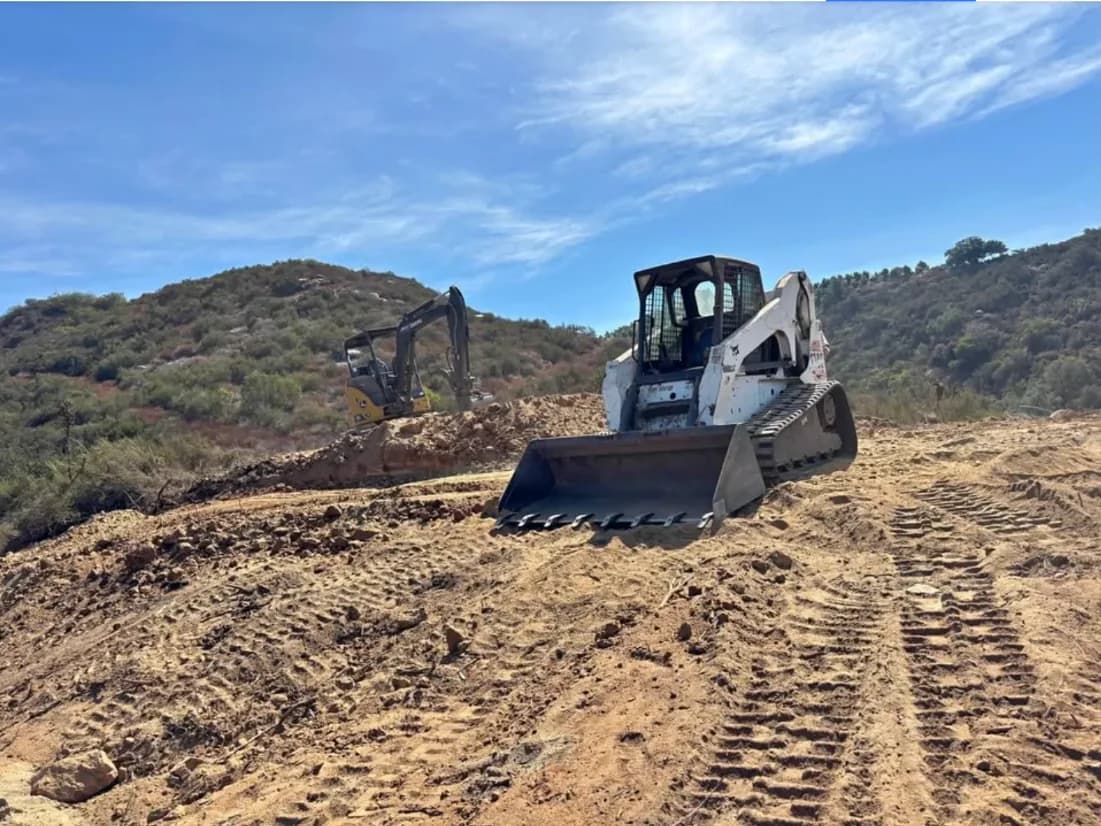
A typical example: a sloped corner of an estate off Olive Hill Road is to become a 50 by 60 foot level turnout, on ground that falls about 7 feet across it. Cutting the high side and filling the low side moves roughly 100 cubic yards of decomposed granite, placed in lifts and track-rolled, and the cut supplies all the fill. That is under the County's 200-cubic-yard line, and neither the cut nor the fill comes near 8 feet. Call it 7 to 8 hours: 7 x $150 = $1,050 to 8 x $150 = $1,200. No material is bought. There is no travel charge in Bonsall.
A worked example on normal ground. Your hours depend on the ground, the access and the material.
Typical hours and cost in Bonsall
Everything is $150 per hour with a 4-hour minimum, with no travel charge. These are the common versions of the job on normal ground.
| Typical job | Hours | At $150 per hour |
|---|---|---|
| Spread 20 tons of DG or base rock delivered to a driveway | 4 | $600 |
| Move a 30-yard stockpile across the property and rough-level it | 4 | $600 |
| Backfill a foundation or a retaining wall after inspection | 4 | $600 |
| Load 5 dump truck loads of spoil for export | 4 to 6 | $600 to $900 |
| Cut and fill 100 cubic yards on a sloped lot | 6 to 10 | $900 to $1,500 |
| Place and track-roll 10 loads of imported fill for a pad | 8 to 12 | $1,200 to $1,800 |
Hours are typical ranges for normal ground and access. Rock, roots, steep slopes and tight gates add time. Material, haul-off and dump fees are quoted separately. 4-hour minimum applies.
What is included
- ✓Cut and fill on the lot: high spots cut, low spots filled, fill placed in lifts and track-rolled
- ✓Spreading delivered fill dirt, DG, base rock, gravel, drain rock or topsoil
- ✓Moving stockpiles, spoil and debris piles to where they belong
- ✓Loading dump trucks and trailers for export, from the pile or from a cut
- ✓Backfill of foundations, retaining walls and utility trenches after inspection
- ✓Rough leveling of the finished material so the next trade starts on grade
The ground in Bonsall
The valley floor along the San Luis Rey is sandy loam over river cobble, which digs easily, drains fast and makes a good base for an arena. The hills on either side are the same decomposed granite as Fallbrook, with granite boulders near the surface on the ridges toward Vista and Fallbrook. The two soils meet on many properties, and a trench that starts in sand can finish in rock.
Permits in Bonsall
Bonsall is unincorporated San Diego County, so any permit comes from County Planning and Development Services. Pads, driveways, trenching, drainage on your own lot and small demolition need none. Larger grading, work in the river floodplain or near a mapped creek, and anything inside the Bonsall Community Plan's resource conservation areas can need County review. Arenas and barns over a certain size need building permits that your builder pulls; the pad itself usually does not.