SoCal Dirt Movers, Fallbrook, CA • Updated
Quick answer
Avocado grove removal in Fallbrook, Bonsall, De Luz and Valley Center costs about $1,800 to $3,600 per acre in labor, which is 12 to 24 hours at $150 per hour. That covers taking the trees down, pulling every stump and root ball with the excavator, filling the holes and rough grading. Chipping or hauling the wood is quoted separately.
At a glance
- Labor per acre
- $1,800 to $3,600 (12 to 24 hours at $150)
- Included
- Trees down, stumps and root balls pulled, holes filled, rough grade
- Extra
- Chipping or hauling the wood, quoted at cost
- 1 acre
- 12 to 24 hours, about 1.5 to 3 working days
- 3 acres
- 36 to 72 hours, $5,400 to $10,800 in labor
- No travel charge
- Fallbrook, Bonsall, De Luz, Rainbow, Pala, Valley Center
How much does it cost to remove an avocado grove per acre?
Removing an avocado grove costs about $1,800 to $3,600 per acre in machine time, which is 12 to 24 hours at $150 per hour with the operator and fuel included. The spread comes from three things: how many trees there are, how big they are, and how steep the ground is. The table shows where typical groves land.
| Grove condition | Hours per acre | Labor per acre |
|---|---|---|
| Stumped or young trees, wide spacing, gentle ground | 12 to 16 | $1,800 to $2,400 |
| Older full-size grove, about 100 trees per acre | 16 to 20 | $2,400 to $3,000 |
| Large trees, dense planting or steep terraces | 20 to 24 | $3,000 to $3,600 |
| Chipping, roll-off or green waste haul | Quoted separately | At cost |
A stumped grove is one a grower cut back to bare trunks years ago to save water. Those trees are lighter to handle, but every stump and root ball is still in the ground and still has to come out.
Why are so many groves in North County coming out?
Water costs and root rot are the two reasons most groves around Fallbrook come out. Avocados need a lot of irrigation, and years of rising water prices have pushed many small groves in Fallbrook, Bonsall and De Luz past the point where the fruit pays the water bill. Root rot finishes off trees that are already stressed, and a grove that has it declines tree by tree.
What is left is a hillside of dead and dying trees, and dead trees are fuel. Within 100 feet of a house or barn they fall under the state defensible space law that your fire district and CAL FIRE inspect to. Many owners pull the rows nearest the buildings first and decide later what to do with the rest.
How is a grove removed?
A grove comes out in five steps, and the stumps are the part that takes the time.
- 1
Walk the grove and find the lines
We walk the rows with you, flag any trees you are keeping, and locate the irrigation mainlines, valves and any power to a pump. 811 does not mark private lines, so what you know about them saves hours.
- 2
Take the trees down
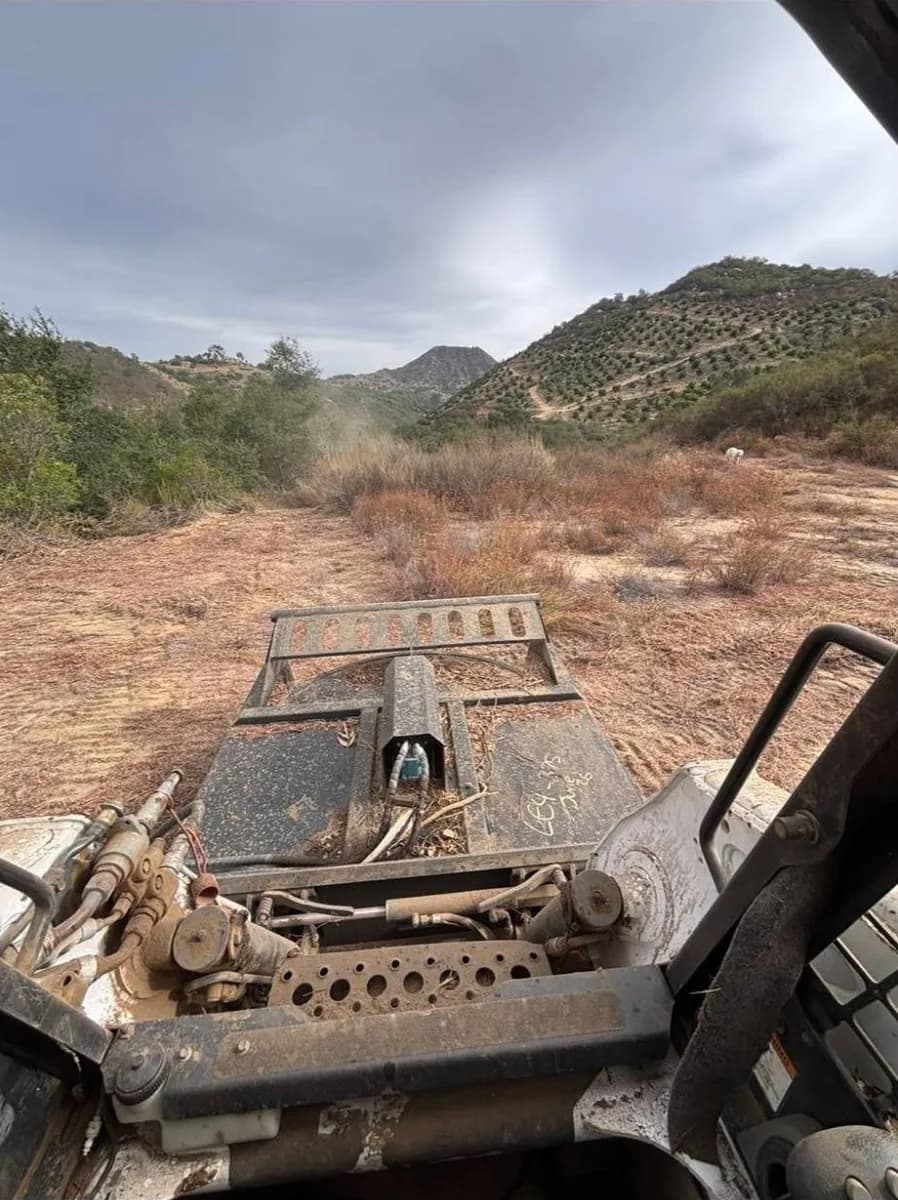
Stumped and small trees are cut with the brush cutter on the Bobcat T300. Full-size trees are pushed over with the loader or pulled with the excavator, which often brings part of the root ball with them.
- 3
Pull every stump and root ball
The mini excavator digs around each stump, pulls it with the bucket and hydraulic thumb, and shakes off the dirt. A live stump left in the ground sends up new shoots, and a dead one rots into a soft spot.
- 4
Pile or load the wood
The loader stacks trunks and branches apart from root balls, ready for the chipper, a roll-off or a pile you keep.
- 5
Fill the holes and rough grade
Each stump hole is filled and track-rolled, and the ground is rough-graded to drain for its next use.
The same two machines do the whole job on one trip, at one rate. See the mini excavator service for what the thumb and buckets handle.
Why does tree count matter more than acreage?
Hours follow the number of stumps, not the size of the parcel, because every stump is its own dig. Older plantings around Fallbrook and Bonsall often have 100 or more trees per acre; a 20 by 20 foot spacing alone works out to about 109. At 12 to 24 hours an acre and 100 trees, that is roughly 7 to 14 minutes per tree to take it down, pull the stump, pile the wood and fill the hole.
Newer high-density plantings can carry more, smaller trees, and a grove stumped years ago has lighter root balls. Big old trees with thick trunks and roots wedged between granite boulders, common up De Luz Road and across Valley Center, are the slow ones. Count the trees in one row and the number of rows when you send photos; nothing tightens a quote more.
What happens to all the wood?
The wood is the second cost after the hours, and you choose how it is handled before the job. Each option is quoted up front.
- Chip on site. A chipper arranged through a local partner turns branches and trunks into mulch you can spread on slopes, around trees you kept, or on the next planting.
- Haul to green waste. The loader fills a roll-off that goes to a green waste facility, priced by the bin.
- Pile and keep. No disposal cost, but a big dry pile is fuel, so keep it well away from buildings.
- Burn. Possible only with a burn permit and only on an allowed burn day. The rules change, so check with your fire district before planning on it.
Root balls hold dirt and rock that are hard on a chipper, so they are usually piled or hauled. We do not bury stumps under ground meant for a pad or a driveway, because the wood rots and the ground settles.
What can the ground become after the grove is gone?
Once the stumps are out and the holes are filled, a former grove can become pasture, a new planting or a building pad.
- Pasture or horse property: rough-graded, fence lines opened, ready to seed. Common in Bonsall and on the Valley Center valley floors.
- Replanting: rows, terraces and grove roads regraded, and new irrigation mainlines trenched. See trenching costs per foot.
- A pad for a house, barn or ADU: cut and fill, compaction and often a County grading permit.
Permits depend on the next use. The County has a separate agricultural grading permit type for land used only for farming, and a pad that moves more than 200 cubic yards, or has a cut or fill over 8 feet high, generally needs a grading permit. Read the grading permit guide before planning a pad on the old grove.
What does removing a 1-acre or 3-acre grove cost?
Two typical examples, worked out the way we quote them. Real hours depend on the trees, the slope and the rock.
- 1
One acre in Fallbrook: about $2,400 to $3,000 plus disposal
An acre of older dead trees, about 100 to the acre, on a moderate slope. That puts it at 16 to 20 hours, $2,400 to $3,000 at $150 per hour, or two to two and a half working days, invoiced at the end of each day. A chipper for the branches and trunks and a roll-off for the root balls are quoted at cost before day one.
- 2
Three acres in Valley Center: about $5,400 to $10,800
Three acres at 12 to 24 hours each is 36 to 72 hours, or $5,400 to $10,800 in labor. Stumped trees on gentle ground land near the bottom: 36 to 48 hours, $5,400 to $7,200. Big live trees on steep terraces land near the top. At 8-hour days that is about 4.5 to 9 working days, with disposal priced separately.
Groves of an acre or more get a free site walk and one number per acre. Valley Center is in our no-travel-charge zone; see our Valley Center page.
Questions people ask
How many avocado trees are on an acre?
Older groves around Fallbrook and Bonsall often have 100 or more trees per acre; a 20 by 20 foot spacing works out to about 109. Newer high-density plantings can carry more. Count the trees in one row and the number of rows, or send a photo down a row, and we can estimate the hours from that before a site walk.
Can you remove part of a grove and keep the healthy trees?
Yes. Flag the trees you want to keep and we work around them, taking out the dead rows and leaving the live ones. Partial removal can take a little longer per tree because the machines work carefully between keepers, but it is common when root rot has hit one part of a grove harder than the rest.
Is it cheaper to cut the trees and leave the stumps?
Cutting only is faster, so it costs less up front. But live avocado stumps resprout, dead ones rot into soft spots, and you cannot grade, disc or build over them. If the ground will ever be pasture, a pad or a new planting, pulling the stumps now with the excavator usually costs less than bringing the machines back later.
Can I burn the avocado wood instead of chipping it?
Only with a burn permit and only on an allowed burn day, and the rules change from season to season, so check with your fire district before planning on it. Most owners find chipping simpler: the chips go back on the ground as mulch, nothing has to be watched or put out, and no smoke drifts over the neighbors.
Should I remove a dead grove for fire safety?
If it is within 100 feet of your house or other buildings, the dead trees and dry leaf litter count as fuel under the state defensible space law, and your fire district can require it cleared. Beyond 100 feet it is your call, but a dead grove below a house on a slope can carry fire uphill toward it. Many owners take out the nearest rows first.
What do you do with the old irrigation lines?
Pull the drip line, hoses and risers before we start if you can, because plastic tangles in the brush cutter and ends up in the chips. Buried PVC mainlines are dug out where they cross the work or left in place where they do not. Tell us where the mainlines, valves and pump wiring run, because 811 does not mark private lines.
Sources
- County PDS Grading Plan Application User Guide
- California Public Resources Code 4291 (defensible space)
Rules change. Check with the agency before you rely on a deadline or a threshold.
How these numbers are worked out. Labor is our published rate, $150 per hour with a 4-hour minimum, times the hours these jobs typically take on normal ground. Material prices are typical delivered prices from North County yards and change with the yard and the distance. For a number on your job, text photos to (442) 271-2748 or send the estimate form.